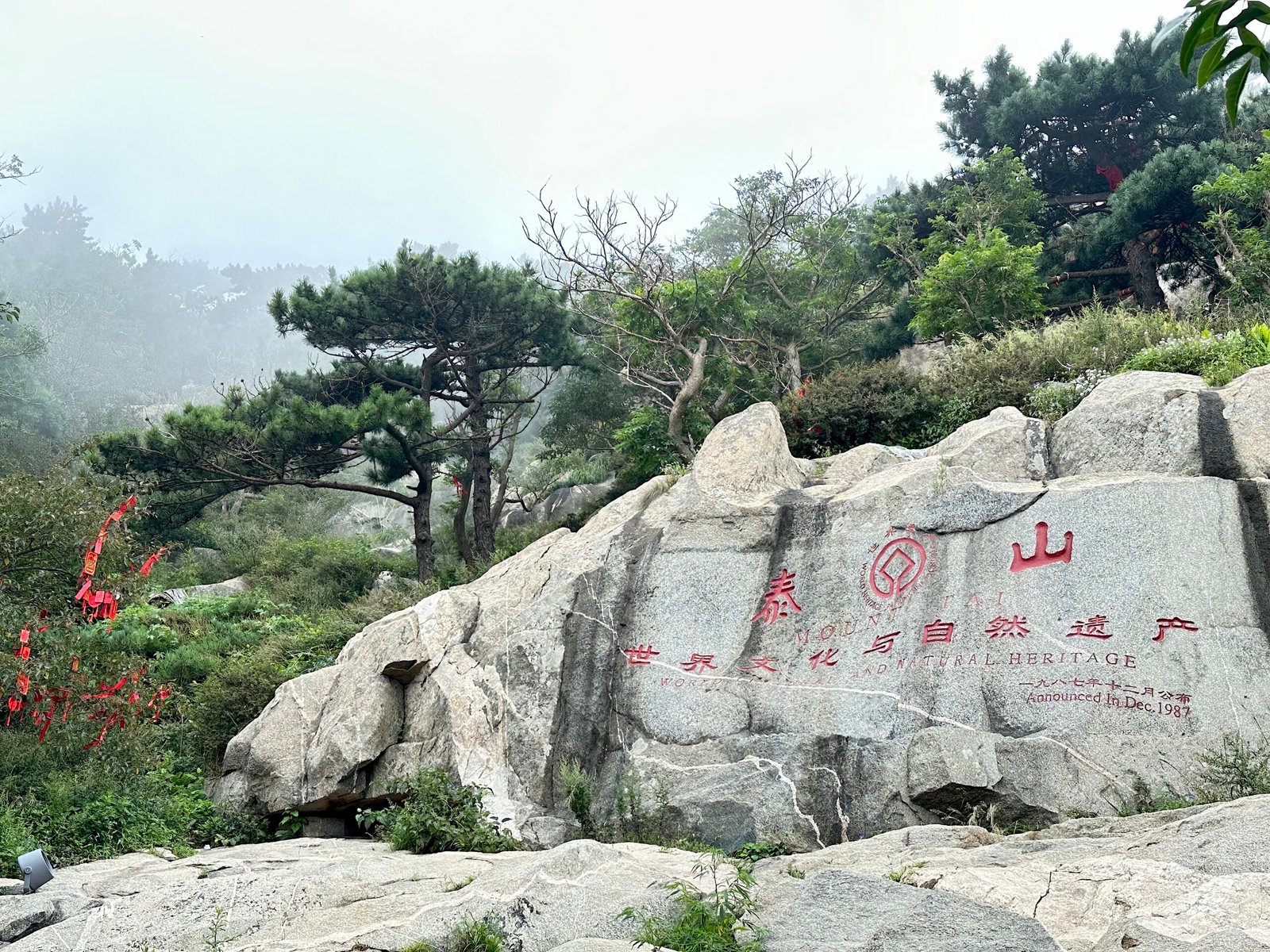
Section 1 — You Came to Climb a Mountain. Emperors Came for Something Much Bigger.
Take the train south from:
Beijing (北京, Běijīng)
toward:
Tai’an (泰安, Tài’ān)
in:
Shandong (山东, Shāndōng),
and one mountain begins dominating the historical landscape:
Mount Tai (泰山, Tàishān).
For modern travelers, the attraction is obvious.
A famous mountain.
Ancient stairways.
Temples.
Stone inscriptions.
Sunrise from the summit.
And:
a serious amount of climbing.
😂
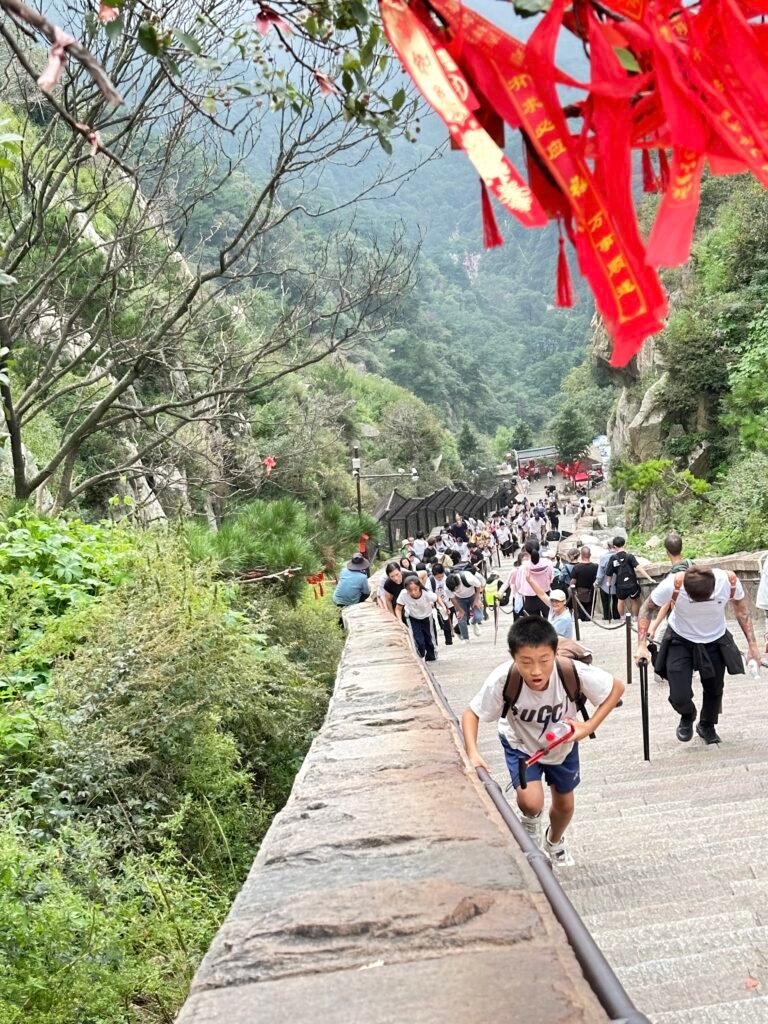
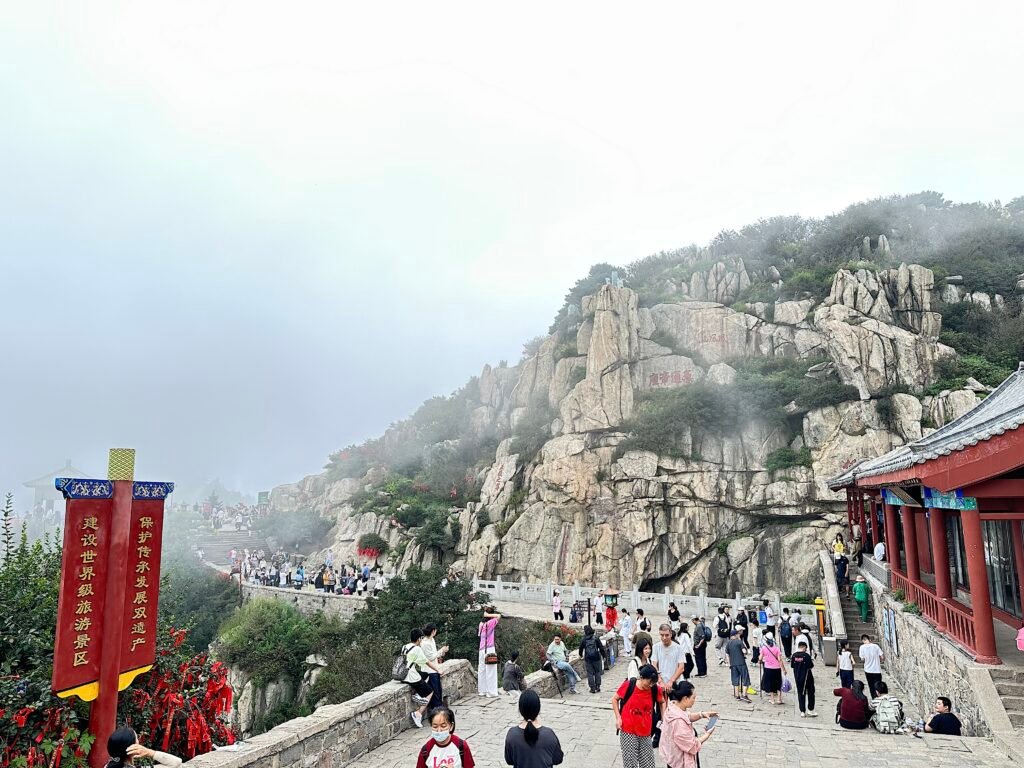
难如登天 (nán rú dēng tiān) — “as difficult as climbing to Heaven.” 😅 Usually it’s just an idiom meaning something is extremely difficult. On Mount Tai (泰山), it starts feeling rather literal. The classic Red Gate route involves about 7,863 stone steps over 9.5 km, with very little level ground, according to the local tourism authority. And just when your legs are asking serious questions about Dad’s itinerary 😂, the famous 十八盘 (Shíbā Pán, Eighteen Bends) still waits near the upper mountain. For a sacred mountain where emperors once performed rites linking earthly rule with 天 (tiān, Heaven), perhaps getting there was never supposed to be easy. Photo by Dad
But Deep China has a more interesting question:
Why did Chinese emperors care so much about THIS mountain?
Because for ancient rulers, Mount Tai wasn’t merely:
beautiful scenery.
It became one of the most important sacred mountains in Chinese political and ritual history!
🔥
First: Read the Name
泰山 — Tàishān
Beginner Chinese:
泰 — tài
grand / exalted / peaceful, depending on context
山 — shān
mountain
So:
泰山
Mount Tai
Easy.
And you’ll see another useful word constantly:
登山 — dēngshān
climb a mountain
登泰山 — dēng Tàishān
climb Mount Tai
🔥
But emperors weren’t coming merely to:
登山.
They were coming to perform:
祭祀 — jìsì
ritual sacrifice / ceremonial offerings.
And sometimes something even more politically charged:
封禅 — fēngshàn.
🐇
🌏 And Yes — Mount Tai Is UNESCO
Mount Tai was inscribed on the:
UNESCO World Heritage List in 1987
as a mixed cultural and natural property.
UNESCO describes it as China’s most famous sacred mountain and notes that it was an object of imperial worship for nearly:
2,000 years.
The mountain preserves an extraordinary combination of:
temples,
stone inscriptions,
ancient trees,
ritual sites
and:
natural landscape.
🔥
So don’t think:
“UNESCO because pretty mountain.”
😂
Its importance is:
NATURE + RELIGION + POLITICS + ART + HISTORY.
That’s what makes Taishan different.
🏔️ Mount Tai Is One of the Five Great Mountains
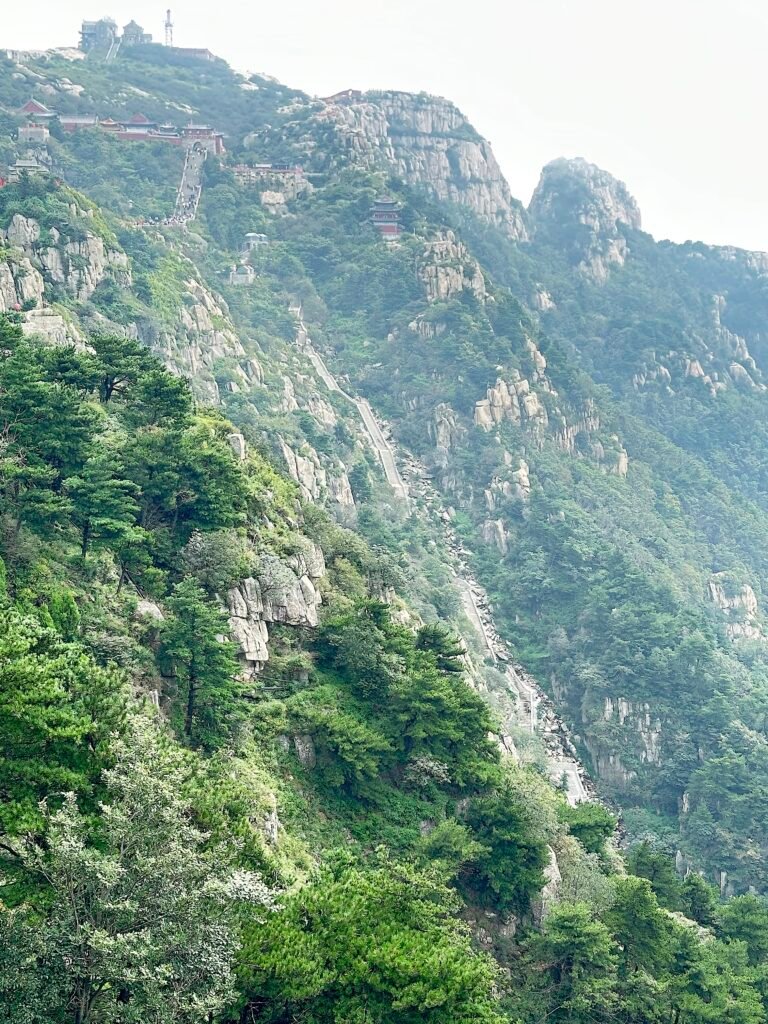
Another useful phrase:
五岳 — Wǔyuè
Five Great / Sacred Mountains
Beginner Chinese:
五 — wǔ
five
岳 — yuè
sacred / great mountain in this historical-cultural context
The traditional Five Great Mountains are associated with the:
east,
south,
west,
north
and:
center.
Mount Tai is:
东岳 — Dōngyuè
Eastern Sacred Mountain
🔥
Beginner Chinese:
东 — dōng
east
So when you see:
东岳泰山
you now know exactly what you’re looking at.
And historically, Mount Tai became the most prestigious of these sacred mountains. UNESCO describes the Five Sacred Mountains tradition as having a history extending for millennia.
🐇 Why EAST?
This is where geography turns into cosmology.
In traditional Chinese systems of thought, directions could be connected with:
seasons,
elements,
colors
and:
cosmic order.
The east was associated with:
sunrise
and:
renewal.
🔥
Mount Tai rises dramatically from the Shandong plain in eastern China.
So over time:
geography
sacred landscape
cosmology
became intertwined.
This isn’t merely:
“People thought mountains were nice.”
Mountains could become places where:
human political order
met:
cosmic order.
😳
Now we’re getting Michelin-ish.
🍚 Western Handrail: Imagine a Mountain as a Political Altar
This is the easiest handrail.
A modern government might use:
parliament buildings,
coronations,
constitutions
or:
national ceremonies
to express legitimacy.
Ancient Chinese rulers also used:
ritual space.
🔥
And Mount Tai became one of the most powerful ritual landscapes available to an emperor.
So don’t imagine an emperor climbing Taishan simply because:
“He liked hiking.”
😭😂
He was walking into:
political theater with cosmic meaning.
👑 Now Meet 封禅 — Fengshan
This is the word that unlocks Mount Tai.
封禅 — fēngshàn
It’s difficult to translate neatly into one English phrase.
Very broadly, it refers to highly prestigious imperial sacrificial rites associated especially with:
Heaven and Earth
and with an emperor’s claim to successful rule.
🔥
UNESCO notes that Mount Tai was one of the principal places where emperors performed these rites and paid homage to:
Heaven and Earth.
Historically recorded fengshan ceremonies at Taishan were rare precisely because they carried enormous symbolic weight.
So:
封禅
was not:
“annual emperor mountain festival.”
😂
It was exceptional.
🌶️ Qin Shi Huang Appears AGAIN
Of course he does.
😂
After:
Qin Shi Huang (秦始皇, Qín Shǐhuáng)
completed the conquest of the rival states in:
221 BCE,
he traveled east and performed major rites at:
Mount Tai.
🔥
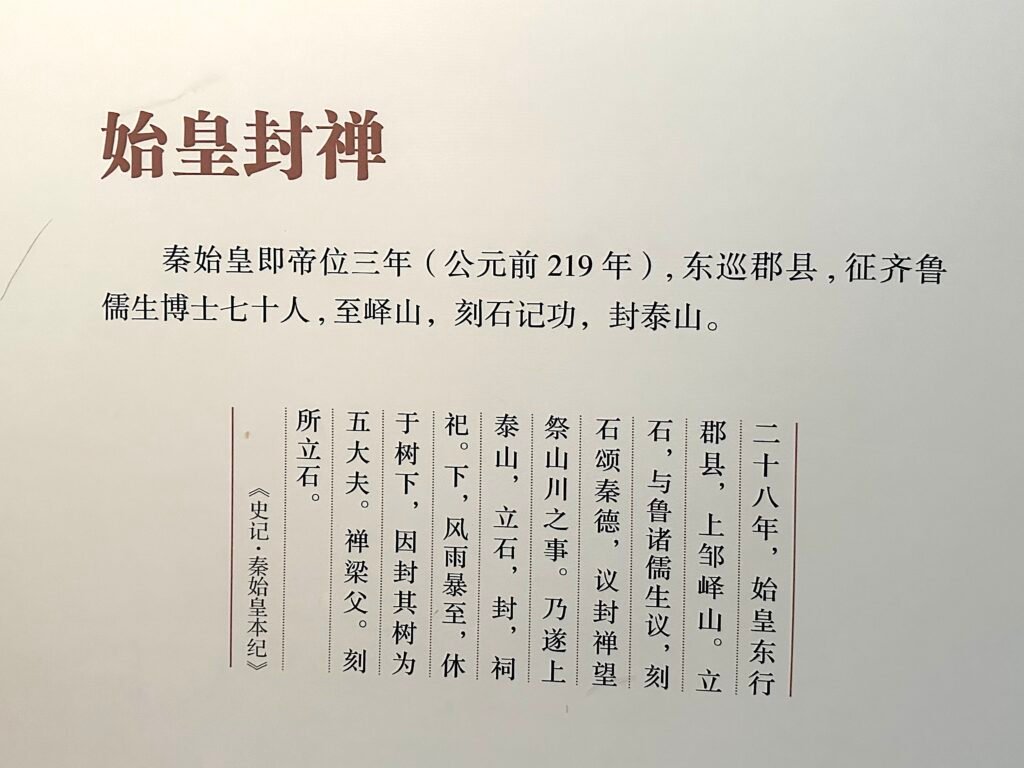
Qin Shi Huang at Mount Tai — explained from ancient Qi. 🐇 Dad photographed this panel at the Qi Culture Museum (齐文化博物馆, Qí Wénhuà Bówùguǎn) in Linzi. Titled 始皇封禅 (Shǐhuáng Fēngshàn), it describes Qin Shi Huang’s visit to Mount Tai in 219 BCE, just two years after Qin conquered Qi and completed the unification of the rival states.
The panel says he summoned 70 Confucian scholars (儒生, rúshēng) from Qi and Lu to discuss the rites, climbed Mount Tai, erected a stone inscription praising Qin’s achievements, and performed the 封禅 (fēngshàn)ceremonies.
And look who turns up again: our old Deep China friend Sima Qian (司马迁, Sīmǎ Qiān)! 😂 The panel quotes his Records of the Grand Historian (《史记·秦始皇本纪》, Shǐjì · Qín Shǐhuáng Běnjì), including the story that a violent storm forced the emperor to shelter beneath a tree during his descent.
Which leaves us with a very Deep China question: Qin Shi Huang had already conquered the states—so why did the most powerful man in China still need Mount Tai? 🐇🔥
Photo by Dad.
UNESCO links the mountain directly with the Qin unification story and the fengshan tradition.
Now stop.
You already know Qin Shi Huang from:
Terracotta Warriors (兵马俑)
and:
What Did Qin Shi Huang Actually “Unify”?
But here he’s doing something completely different.
At Xi’an:
QIN POWER
looks like armies, administration and unification.
At Taishan:
QIN POWER
looks like:
RITUAL LEGITIMACY.
😳
Same emperor.
Different doorway.
🐇 Why Does a Victorious Emperor Need Heaven?
Excellent question.
If Qin Shi Huang had already:
won the wars,
why bother with sacred mountains?
Because military victory answers:
Who defeated the other states?
It does NOT automatically answer:
Why should this new political order be regarded as legitimate?
🔥
Chinese political traditions increasingly connected rulership with:
Heaven (天, Tiān).
And emperors came to describe themselves as:
Son of Heaven (天子, Tiānzǐ).
Beginner Chinese:
天 — tiān
Heaven / sky
子 — zǐ
son
So:
天子
Son of Heaven
Now our Taishan article has collided with another Michelin Big Question:
Why Does Chinese History Keep Talking About Heaven?
🐇
Exactly where we want the traveler to go.
🌌 Heaven Is NOT Simply “God”
Important.
Western travelers often see:
天 — Tiān
translated as:
Heaven
and immediately imagine:
the Christian God.
Careful.
🔥
The meanings and functions of 天 changed across Chinese history and philosophical traditions.
It can relate to ideas involving:
cosmic order,
moral order,
the sky / heavens
and:
political legitimacy.
So don’t force:
天
into one Western theological box.
That’s why learning the Chinese word helps.
🐇 Remember the Temple of Heaven?
Now go back to:
Beijing.
First-time travelers visit:
Temple of Heaven (天坛, Tiāntán).
Beautiful blue roof.
Great photographs.
😂
But UNESCO reminds us that Ming and Qing emperors went there as intermediaries between the human and celestial realms, making sacrifices and praying for good harvests.
Now compare:
BEIJING — 天坛
emperor performs ritual to Heaven
with:
TAISHAN — 封禅
emperor performs extraordinary rites connected with Heaven, Earth and political order.
🔥
Suddenly the Temple of Heaven makes:
more sense
after visiting Mount Tai.
And Mount Tai makes more sense after visiting:
Beijing.
That’s exactly why Taishan belongs in:
Beyond Beijing.
🪨 And Once Again: READ THE STONES
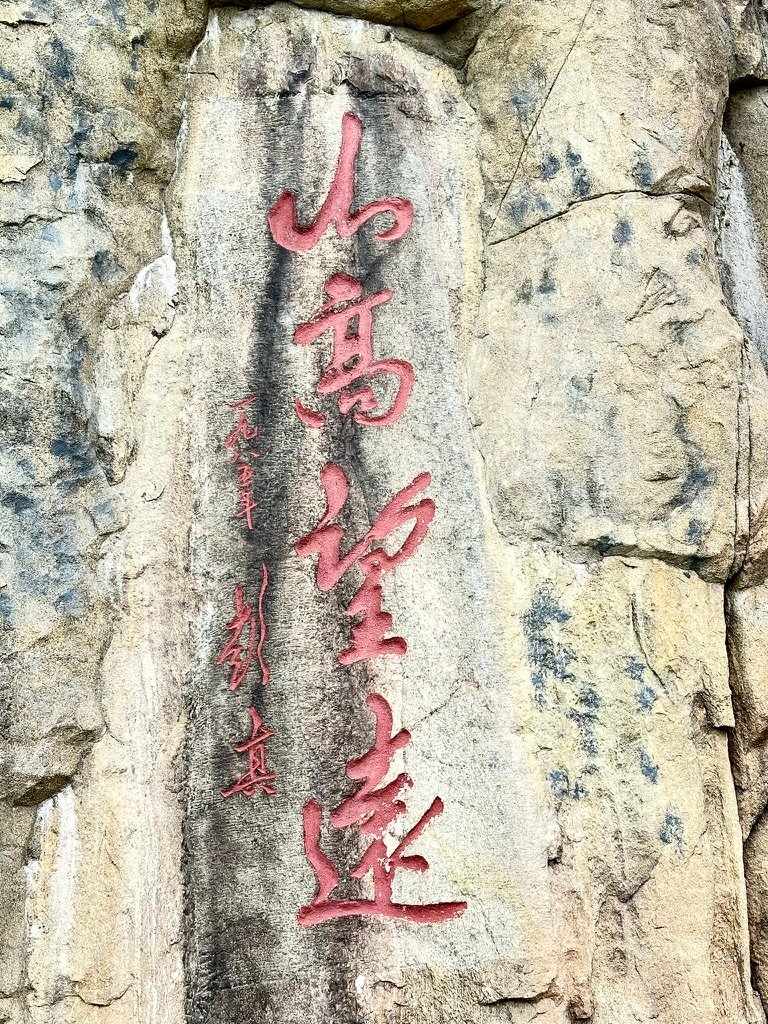
😂
Dad’s favorite Chinese-history technology.
Mount Tai contains an extraordinary concentration of:
stone inscriptions (石刻, shíkè)
and:
steles (碑, bēi).
UNESCO records around:
1,800 stone tablets and inscriptions
across the heritage landscape.
Beginner Chinese:
石 — shí
stone
刻 — kè
carve / engrave
So:
石刻 — shíkè
stone carving / rock inscription
🔥
Emperors.
Officials.
Scholars.
Religious communities.
Generations kept:
writing on the mountain.
Just like Qufu, the landscape becomes:
a historical archive written in stone.
👀 Don’t Just Photograph the Calligraphy
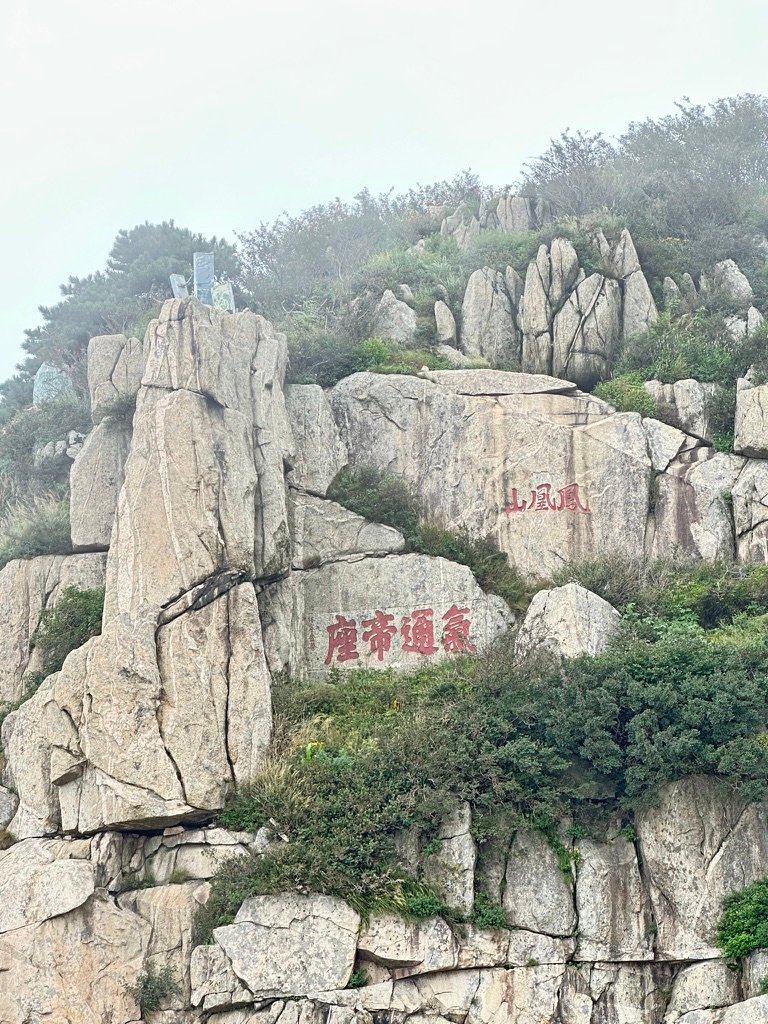
When you see giant Chinese characters carved into Mount Tai:
don’t merely think:
Cool Chinese calligraphy.
😂
Ask:
WHO wrote it?
WHEN?
WHY here?
An inscription might reveal:
imperial patronage,
religious devotion,
political claims,
literary culture
or:
someone’s response to the landscape.
🔥
At Mount Tai:
nature itself became a writing surface.
That’s extraordinarily Chinese-history-rich.
🐇 Then Confucius Appears
Of course he does too.
😂
Mount Tai is geographically and culturally close to:
Qufu (曲阜).
Confucius became strongly associated with Mount Tai in later cultural memory, and UNESCO explicitly connects Taishan with the emergence and development of Confucianism.
So our Shandong journey begins connecting itself:
TAISHAN
↓
Heaven
↓
emperor
↓
ritual
↓
legitimacy
↓
QUFU
↓
Confucius
↓
ritual (礼)
↓
education
↓
government.
😳
That’s no longer:
two Shandong attractions.
It’s:
one historical conversation.
🌶️ The Emperor Needs BOTH Power and Ritual
This may be the most important idea in Section 1.
An emperor needs:
军 — jūn
military force
but also:
礼 — lǐ
ritual / proper order
and:
名分 — míngfèn
recognized status / proper political-social position, depending on context.
🔥
Winning territory can make you:
powerful.
Ritual helps communicate:
what that power means.
That distinction helps explain why sacred places like Taishan mattered politically.

🐞 That’s the First Sting
You came to:
Mount Tai (泰山)
thinking:
“Famous Chinese mountain. Let’s climb it.”
Then:
山 — mountain
↓
五岳 — Five Sacred Mountains
↓
东岳 — Eastern Sacred Mountain
↓
祭祀 — ritual sacrifice
↓
封禅 — fengshan
↓
Qin Shi Huang
↓
unification
↓
Heaven (天)
↓
Son of Heaven (天子)
↓
political legitimacy.
😬
And suddenly the real Mount Tai question isn’t:
“How many steps to the summit?”
It’s:
“Why did emperors need a mountain to help explain why they deserved to rule?”
🔥🔥🔥
That’s the Michelin doorway.
And in Section 2, we’re going much deeper:
What exactly were the fengshan 封禅 rites — and why were emperors so cautious about claiming the right to perform them?
Because at Mount Tai:
climbing the mountain was the easy part.
😂🐇🔥
Section 2 — Fengshan 封禅: When Climbing Mount Tai Became a Statement About Who Deserved to Rule
Section 1 left us with a strange question.
An emperor already has:
an army (军队, jūnduì),
officials (官员, guānyuán),
territory (疆域, jiāngyù),
taxes (赋税, fùshuì)
and:
political power (权力, quánlì).
So why climb:
Mount Tai (泰山, Tàishān)
and perform elaborate ceremonies?
😂
Because:
having power
and:
explaining why your power is legitimate
are not quite the same thing.
🔥
And that brings us to one of the most fascinating words you’ll encounter at Mount Tai:
封禅 — fēngshàn.
First: What Does 封禅 Mean?
This is difficult to translate neatly.
The term refers to an exceptional set of imperial rites associated particularly with:
Mount Tai
and traditionally involving sacrifices connected with:
Heaven (天, Tiān)
and:
Earth (地, Dì).
Beginner Chinese:
天 — tiān
Heaven / sky
地 — dì
earth / land
Together:
天地 — tiāndì
Heaven and Earth
🔥
In the traditional description of the rites:
封 — fēng
was associated with a ceremony on Mount Tai itself, connected with Heaven.
And:
禅 — shàn
with a ceremony on a nearby hill, connected with Earth.
But don’t reduce this to:
“Emperor worships sky on top, then worships earth at bottom.”
😂
The political meaning was much bigger.
👑 Fengshan Was a Claim About the Emperor’s Rule
Performing:
封禅
could proclaim something extraordinary:
The realm is successfully ordered, and the ruler is worthy to report his achievement to Heaven and Earth.
🔥
That’s why emperors couldn’t casually say:
“Weather looks nice. Let’s do fengshan this weekend.”
😂
The rites carried enormous:
political
ritual
and:
cosmological
weight.
To perform them was to make a very large statement about:
your own reign.
🍚 Western Handrail: Not Quite a Coronation
Western readers may be tempted to think:
“Oh, so fengshan was China’s coronation.”
No.
Useful handrail.
Wrong equivalence.
😂
An emperor didn’t normally need to perform fengshan in order to become emperor.
Many enormously important emperors:
never performed it.
So think instead of an extraordinary public claim that:
the emperor’s rule had achieved a level of order and success worthy of cosmic recognition.
🔥
That helps explain why:
very few rulers
could comfortably make that claim.
🏅 Dad’s Handrail: The Imperial “All-Star” Claim
Plenty of emperors worshiped at Mount Tai.
But the full 封禅 (fēngshàn) rites were another matter.
Only a small number of emperors are conventionally recognized as having actually performed them.
Why so few?
Think of 封禅 as something like making an enormous imperial “all-star” claim:
My achievements are exceptional. My rule is successful. I am worthy of reporting this age to Heaven.
😂
An emperor could claim it.
But history—and everyone watching—could also ask:
“Really?”
🔥
That’s why Mount Tai wasn’t merely a sacred mountain.
It could become a stage on which:
POWER
tried to demonstrate:
LEGITIMACY.
And across more than a thousand years of imperial history, relatively few rulers made the full 封禅 claim.
ONLY 6 emperors are generally recognized as having actually performed the formal Fengshan rites at Mount Tai
- Qin Shi Huang 秦始皇 — 219 BCE
- Emperor Wu of Han 汉武帝 — first in 110 BCE; he subsequently repeated the rite multiple times
- Emperor Guangwu of Eastern Han 汉光武帝 — 56 CE
- Emperor Gaozong of Tang 唐高宗 — 666 CE, with Wu Zetian 武则天 participating prominently
- Emperor Xuanzong of Tang 唐玄宗 — 725 CE
- Emperor Zhenzong of Song 宋真宗 — 1008 CE
A Chinese government source discussing ancient mountain ritual explicitly says that after Qin Shi Huang and Han Wudi, only Guangwu, Tang Gaozong, Tang Xuanzong and Song Zhenzong actually performed Fengshan—giving us six emperors in total.
And there is a wonderful detail for our article:
汉武帝 was the Fengshan enthusiast 😂
The Dengfeng government history records six Fengshan ceremonies by Emperor Wu of Han alone: 110, 106, 102, 98, 93 and 89 BCE.
So six emperors ≠ six ceremonies.
UNESCO notes 12 historically recorded imperial ceremonies honoring Heaven and Earth at Taishan, while broader counts of emperors who came to Taishan for sacrifices/ritual visits can be larger because later emperors worshipped there without performing the full 封禅 ceremony.
This gives us a very useful Deep China distinction:
Many emperors worshipped at Mount Tai. Very few dared to perform 封禅.
Only six emperors across more than a thousand years are conventionally counted as actually doing it.
And after Song Zhenzong 宋真宗 in 1008, the formal imperial Fengshan tradition at Taishan effectively ended; later emperors, including Qing rulers, continued to honor and sacrifice at Mount Tai, but did not revive the full Fengshan ceremony.
🐇 Qin Shi Huang Had a Special Reason
Now bring back:
Qin Shi Huang (秦始皇, Qín Shǐhuáng).
In:
221 BCE
Qin completed its conquest of the rival states.
The King of Qin didn’t simply become:
“King of a bigger Qin.”
He adopted the unprecedented imperial title:
皇帝 — huángdì
emperor
and became:
始皇帝 — Shǐ Huángdì
First Emperor
🔥
Then he traveled east.
To:
Mount Tai.
Think about what had just happened.
Several competing political states had been brought under:
one imperial ruler.
Now the new emperor had to explain:
what this new order meant.
🐇
Mount Tai gave him an extraordinary ritual stage.
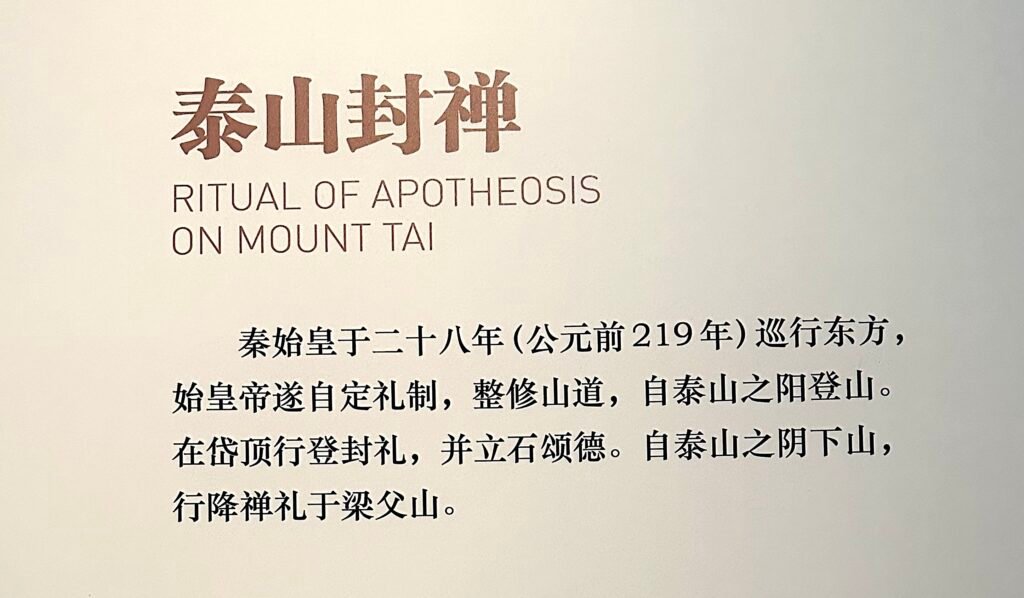
He had unified the states. Now he had to explain why he deserved to rule them. Dad photographed this panel on 泰山封禅 (Tàishān Fēngshàn) at the Qi Culture Museum in Linzi.
In 219 BCE, only two years after completing the conquest of the rival states, Qin Shi Huang (秦始皇) traveled east to Mount Tai, prepared the ritual route, climbed the mountain and performed 封 (fēng) at the summit; the panel says he then descended and performed 禅 (shàn) at nearby Liangfu Mountain (梁父山).
He also erected a stone inscription praising the achievements and virtue of the new Qin order. The political point matters: military victory could make Qin Shi Huang the most powerful ruler in the realm, but power and legitimacy were not quite the same thing.
At sacred Mount Tai, the First Emperor could present his unprecedented political achievement within a much larger cosmic and ritual order.
In Dad’s language: the acquisition was complete—now the new Group CEO was making the ultimate “all-star” claim to Heaven. 😂🔥 Photo by Dad.
🌶️ Remember: Military Unification Is Only Part of Unification
Our Qin Michelin course already asked:
What did Qin Shi Huang actually “unify”?
Territory?
Yes.
But Qin also pursued forms of:
administrative standardization,
weights and measures,
writing practices,
roads
and:
imperial political authority.
🔥
At Mount Tai, another dimension appears:
SYMBOLIC ORDER.
You don’t merely conquer:
天下 — tiānxià.
You explain your place within it.
A Very Important Chinese Word: 天下
天下 — tiānxià
Beginner Chinese:
天 — tiān
Heaven
下 — xià
below / under
So literally:
天下
“All Under Heaven”
🔥
But historically, 天下 is much richer than simply:
“the country of China.”
Depending on context, it can refer to the wider political and moral world conceived as:
under Heaven.
So when an emperor claims authority over:
天下,
we’re entering a political imagination much larger than:
“I own this territory on the map.”
🐇 And Who Rules 天下?
Remember Section 1:
天子 — Tiānzǐ
Son of Heaven
The emperor is:
天子.
The realm is:
天下.
And political legitimacy becomes connected with:
天命 — Tiānmìng
Mandate of Heaven.
😳
Now three beginner Chinese words suddenly fit together:
天 — Heaven
↓
天命 — Heaven’s mandate
↓
天子 — Son of Heaven
↓
天下 — All Under Heaven.
🔥🔥🔥
That is an entire political worldview hiding inside one character:
天.
🌌 But Where Did the Mandate of Heaven Come From?
Not Qin.
Go backward.
Zhou dynasty (周朝, Zhōu Cháo).
When the Zhou overthrew the:
Shang dynasty (商朝, Shāng Cháo),
Zhou political ideology developed the enormously influential concept of:
天命 — Tiānmìng.
Very broadly:
Heaven could authorize rule.
But that authorization was not necessarily:
permanent.
🔥
A ruling house that failed catastrophically could lose:
the Mandate.
That gave later Chinese historical thought a powerful way to explain:
dynastic change.
🍚 Dad’s Political Science Handrail
This is brilliant political technology.
😂
Imagine:
Dynasty A rules.
Then Dynasty B overthrows it.
Dynasty B needs to explain:
“Why are WE legitimate rather than merely successful rebels?”
One answer:
Dynasty A – lost the Mandate of Heaven.
And:
Dynasty B – received it.
🔥
Political change can therefore be interpreted inside:
a moral-cosmic framework.
Victory alone isn’t the whole explanation.
Legitimacy matters.
🐇 Remember Dad & Elaine at Zhouyuan?
Now our travel map connects again.
Dad & Elaine followed the Zhou story toward:
Zhouyuan (周原, Zhōuyuán)
and:
Qishan (岐山, Qíshān)
in Shaanxi.
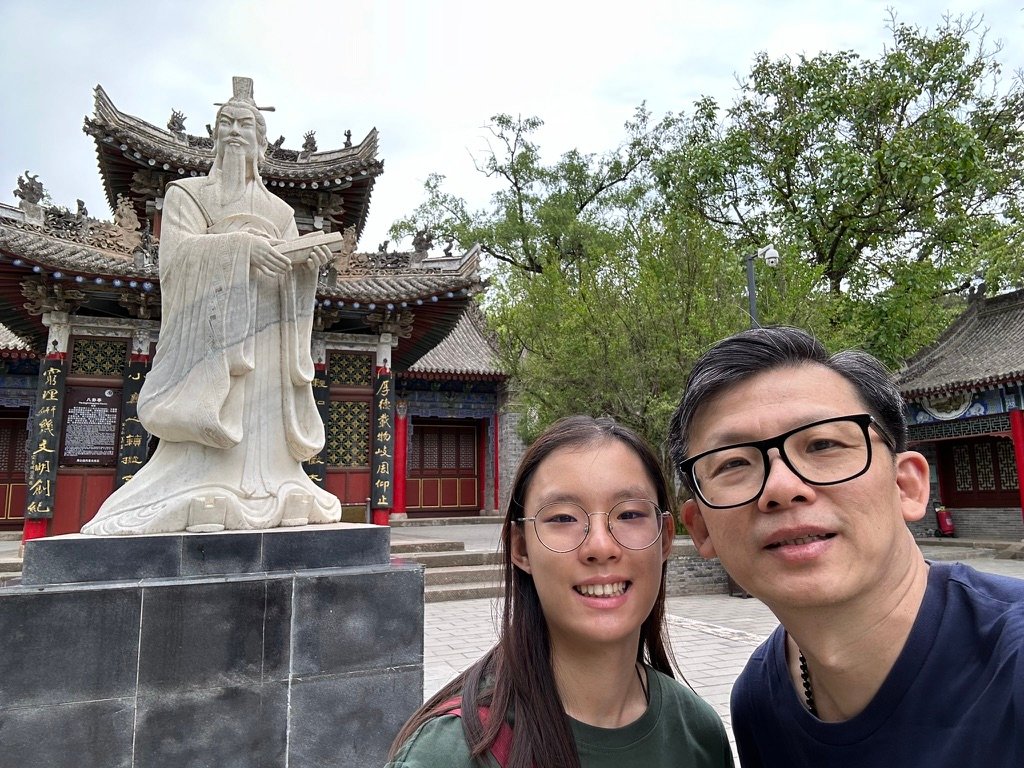
There we encountered:
Duke of Zhou (周公, Zhōugōng)
and the political world in which Zhou ideas about legitimate rulership developed.
🔥
Then hundreds of years later:
Qin Shi Huang
climbs:
Mount Tai.
Different dynasty.
Different political system.
But the relationship between:
ruler
and:
cosmic order
remains enormously important.
One place leads to another.
🐇
👑 Qin Wasn’t the Only Emperor to Perform Fengshan
Later rulers also looked toward:
Mount Tai
and its enormous ritual prestige.
One particularly famous example was:
Emperor Wu of Han (汉武帝, Hàn Wǔdì).
🔥
Remember him?
Dad & Elaine keep finding this emperor everywhere.
😂
挂甲柏 — Armor-Hanging Cypress
with a tradition associated with Han Wudi.
Northern frontier:
Han campaigns.
Silk Roads:
Han expansion.
And now:
Mount Tai.
Han Wudi performed fengshan ceremonies there.
Another rabbit connects.
🐇 Why Han Wudi?
Think about his reign.
The Han state had become:
powerful,
expansive
and:
imperially confident.
So Mount Tai provided a place where imperial success could be expressed through:
ritual.
🔥
Again:
military achievement
+
political authority
+
cosmic legitimacy
meet on:
a mountain.
This is why Taishan is so much more interesting than:
“Nice sunrise.”
😂
🌶️ But Fengshan Was Dangerous Politically
Here’s the delicious part.
If performing fengshan implies:
“My reign is extraordinarily successful and Heaven recognizes the order I’ve created,”
then what happens if:
the empire is unstable,
people are suffering,
rebellions are occurring,
or:
your government is obviously struggling?
😬
You may look:
ridiculous.
Or worse:
arrogant before Heaven.
🔥
So choosing NOT to perform fengshan could itself be politically meaningful.
The ritual’s prestige depended partly on:
its rarity.
🍚 Western Handrail: Don’t Give Yourself Five Michelin Stars
😂
Imagine a chef announcing:
“I hereby award myself the greatest culinary honor on Earth.”
Everyone looks around.
Food had better be:
VERY good.
😭😂
Fengshan carried a much deeper religious-political meaning than that joke, obviously.
But the handrail works:
the bigger the claim, the greater the risk if reality doesn’t support it.
An emperor claiming extraordinary harmony and achievement needed:
a convincing reign.
🪨 And Then the Mountain Becomes the Record
Now look again at Mount Tai’s:
stone inscriptions (石刻, shíkè)
and:
steles (碑, bēi).
Different rulers and generations left records on the mountain.
🔥
😂 Dad’s Tech Handrail: China’s Imperial “Rockchain”?
Different emperors.
Different dynasties.
Different centuries.
Yet they kept leaving:
石刻 — shíkè
stone inscriptions
and:
碑 — bēi
steles
on the same mountain.
Dad looked at all this stone and thought:
Blockchain?
No.
ROCKCHAIN.
😂🪨
Each generation adds another historical record to the mountain.
Who came.
When.
What they claimed.
What they commemorated.
What they wanted later generations to remember.
Of course, this isn’t literally a blockchain.
But as a beginner’s handrail, it works:
Mount Tai itself became part landscape, part archive.
Layer after layer of inscriptions turned the mountain into a physical record of how different generations understood:
天 — Heaven
权力 — quánlì — power
正统 — zhèngtǒng — legitimate political succession
and:
皇权 — huángquán — imperial authority.
So when you climb Taishan:
don’t just look at the rocks.
READ THE ROCKCHAIN.
😂🔥
So Taishan becomes something like:
a political archive written onto sacred geography.
At Qufu:
Confucius’s memory
accumulated in stone.
At Taishan:
imperial and sacred memory
accumulated in stone.
😳
Now our Shandong journey is connecting itself again.
Another Useful Word: 功
When emperors discussed achievement, you’ll encounter:
功 — gōng
achievement / merit
and:
功德 — gōngdé
merit / virtuous achievement, depending on context.
🔥
An emperor’s monumental inscriptions could celebrate:
功 — achievements.
So when you encounter imperial writing carved into a sacred landscape, ask:
Whose version of history am I reading?
That’s a very Deep China question.
😂
Stone lasts.
But stone can still contain:
political messaging.
🐇 Then Why Did Fengshan Eventually Fade?
This is important.
Mount Tai remained sacred and enormously important.
Emperors continued visiting, sacrificing, inscribing and patronizing the mountain.
But:
fengshan itself did not remain a routine imperial ceremony forever.
🔥
Later imperial ritual developed other major centers and forms.
And eventually:
Beijing
became home to one of the most famous ritual complexes in the world:
Temple of Heaven (天坛, Tiāntán).
Now the rabbit runs north.
🐇
🏛️ From Sacred Mountain to Imperial Capital
Think about the contrast.
At:
Mount Tai
the emperor enters:
a sacred natural landscape.
At:
Temple of Heaven
the imperial state creates:
a monumental ritual landscape inside its capital.
🔥
Different place.
Different historical period.
Related question:
How should the emperor communicate with Heaven?
That’s why a traveler who has already visited:
天坛
in Beijing should come to:
泰山.
And why someone who climbs Taishan should look at the Temple of Heaven differently when returning to Beijing.
🌾 And What Did Emperors Ask Heaven For?
Not simply:
“Please let me remain emperor.”
😂
One crucial concern was:
agriculture.
Harvests mattered enormously to an agrarian empire.
At Beijing’s Temple of Heaven, Ming and Qing emperors performed important rituals including prayers for:
good harvests (丰收, fēngshōu).
Beginner Chinese:
丰 — fēng
abundant
收 — shōu
harvest / receive
So:
丰收
abundant harvest / good harvest.
🔥
Now:
Heaven
connects with:
food.
And food connects with:
government.
Again.
🌶️ A Bad Harvest Can Become a Political Problem
Remember our Yellow River fried rice?
flood (洪水, hóngshuǐ)
drought (旱灾, hànzāi)
agriculture (农业, nóngyè)
water control (治水, zhìshuǐ).
Natural disaster isn’t merely:
weather.
In imperial political culture, severe disasters could provoke discussion about:
the quality of government
and:
the moral condition of rulership.
🔥
Now our Shandong menu is linking again:
JINAN / WATER
↓
TAISHAN / HEAVEN
↓
QUFU / GOVERNMENT & RITUAL.
Geography.
Cosmology.
Politics.
One journey.
🐇 And Confucian Thinkers Complicate Heaven
Remember:
Confucius (孔子)
and:
儒家 — Rújiā.
Confucian thinkers didn’t all discuss:
天
in exactly the same way.
Ideas about Heaven developed and changed across centuries.
🔥
That’s another reason not to translate:
天 = God
and stop thinking.
Depending on the text and period, Heaven can carry:
cosmological,
moral,
natural
and:
political meanings.
The Chinese word itself helps us preserve:
the complexity.
🐞 Now the Mountain Has Changed
You started Section 2 thinking:
封禅 = emperor performs ceremony on mountain.
Now:
封禅
↓
Qin Shi Huang
↓
unification
↓
天下 — All Under Heaven
↓
天子 — Son of Heaven
↓
天命 — Mandate of Heaven
↓
Zhou
↓
dynastic legitimacy
↓
Han Wudi
↓
imperial achievement
↓
stone inscriptions
↓
Temple of Heaven
↓
harvests
↓
government.
😬
One mountain has become:
a political theory class.
😭😂
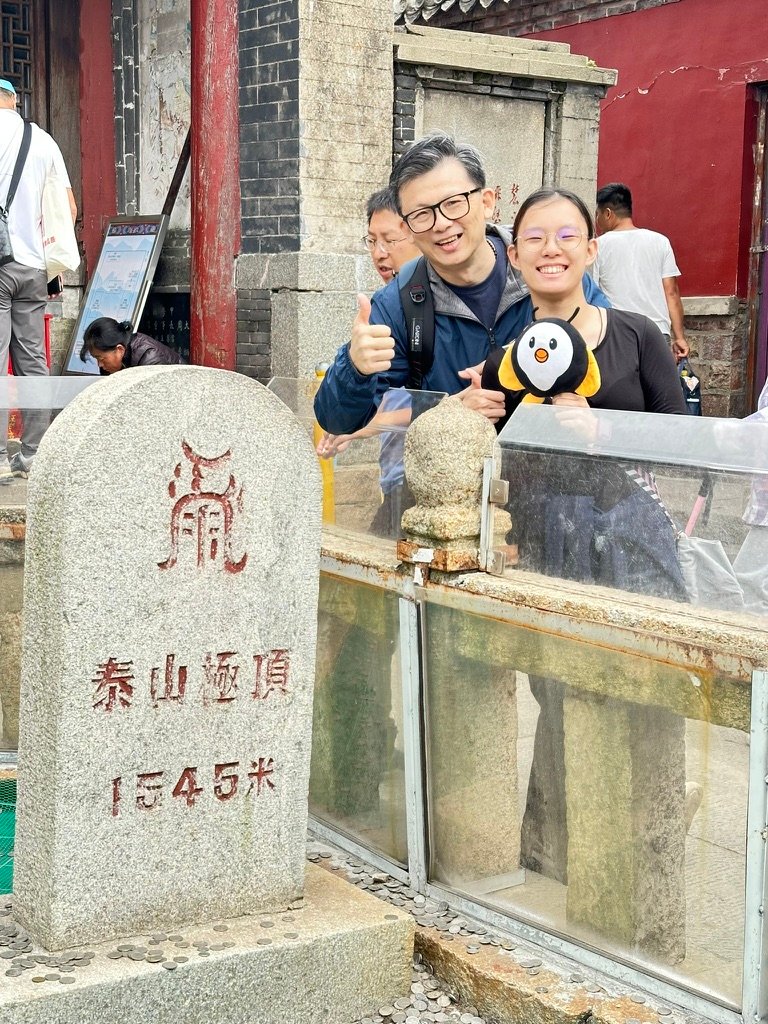
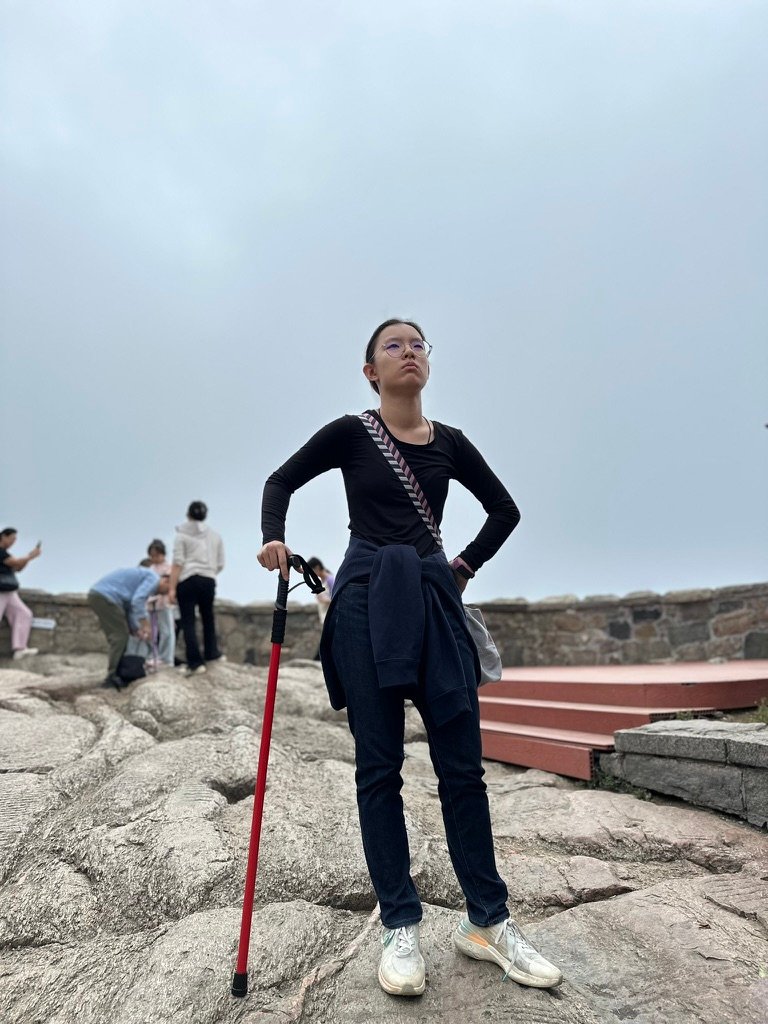
⛰️ Photo Note: We Made It!
After thousands of stone steps, Dad and Elaine finally reached the summit of Mount Tai (泰山) — 1,545 meters above sea level. 😂💪
For emperors, reaching the summit could mean approaching Heaven. For us?
It meant tired legs, a very big thumbs-up — and proof that we actually made it.
Photo from Dad & Elaine’s Mount Tai climb.
🌶️ The Bigger Lesson
Mount Tai helps us understand something first-time travelers often miss.
Chinese imperial government wasn’t explained only through:
FORCE.
It was also explained through:
RITUAL
MORAL ORDER
HISTORY
and:
HEAVEN.
🔥
The emperor wasn’t simply:
the man with the biggest army.
He was:
天子 — Son of Heaven
claiming a legitimate place within:
天下 — All Under Heaven.
That claim needed:
political language.
It needed:
ritual.
And at certain extraordinary moments:
it needed Mount Tai.
🐞 Halfway Sting Check
You came to Taishan asking:
“Why would an emperor climb this mountain?”
Now the answer is becoming clearer.
Not simply to:
reach the summit.
But to connect:
EARTHLY POWER
with:
COSMIC ORDER.
🔥
And now another question appears:
If Heaven could authorize an emperor… could Heaven also REMOVE him?!
😬🐇
Oh yes.
That’s where:
Mandate of Heaven (天命)
gets dangerous.
Because once a dynasty begins collapsing…
floods,
famines,
rebellions,
defeats
and:
political disorder
can start telling a very different story.
🐇🔥
But Dad isn’t turning the Taishan fried rice into the entire Michelin Heaven course.
😂
Section 3 — How to Visit Mount Tai — and Actually See More Than a Mountain
By now Dad has done it again.
😂
You came to:
Mount Tai (泰山, Tàishān)
to climb one of China’s most famous mountains.
Now you’re carrying around:
Heaven (天, tiān),
Earth (地, dì),
Son of Heaven (天子, Tiānzǐ),
Mandate of Heaven (天命, Tiānmìng),
All Under Heaven (天下, tiānxià),
fengshan rites (封禅, fēngshàn),
Qin Shi Huang (秦始皇),
Emperor Wu of Han (汉武帝)
and:
political legitimacy.
😬
Excellent.
🐞
Now let’s return to the practical question:
How do you actually visit Mount Tai?
🚄 First: Go to Tai’an 泰安, Not “Taishan City”
Mount Tai rises beside:
Tai’an (泰安, Tài’ān)
in:
Shandong (山东, Shāndōng).
For high-speed rail travelers, one of the important stations is:
Tai’an Railway Station (泰安站, Tài’ān Zhàn).
Beginner Chinese:
站 — zhàn
station
So:
泰安站
Tai’an Station
🔥
Tai’an is well connected by high-speed rail with major cities including:
Beijing (北京)
and:
Jinan (济南, Jǐnán).
That makes Mount Tai a very realistic:
Beyond Beijing
extension.
And it becomes even better if you’re building a wider:
Shandong history journey.
🗺️ Dad’s Better Shandong Route
Don’t necessarily think:
Beijing → Taishan → Beijing.
You can build:
BEIJING 北京
↓
JINAN 济南
↓
MOUNT TAI 泰山
↓
QUFU 曲阜
↓
and continue deeper into Shandong.
🔥
Now the transport route becomes:
a history-learning route.
That’s exactly what our future:
Shandong Michelin Journey Menu
will be designed to do.
🥾 Do You Have to Climb Mount Tai From the Bottom?
NO.
😂
This is extremely important for international travelers who read:
“Climb Mount Tai!”
and imagine Dad demanding several hours of stone steps before they’re allowed to understand Chinese history.
😭😂
There are different ways to experience the mountain.
You can make the journey:
more physical
or:
less physical
depending on your:
fitness,
age,
weather,
time
and:
travel style.
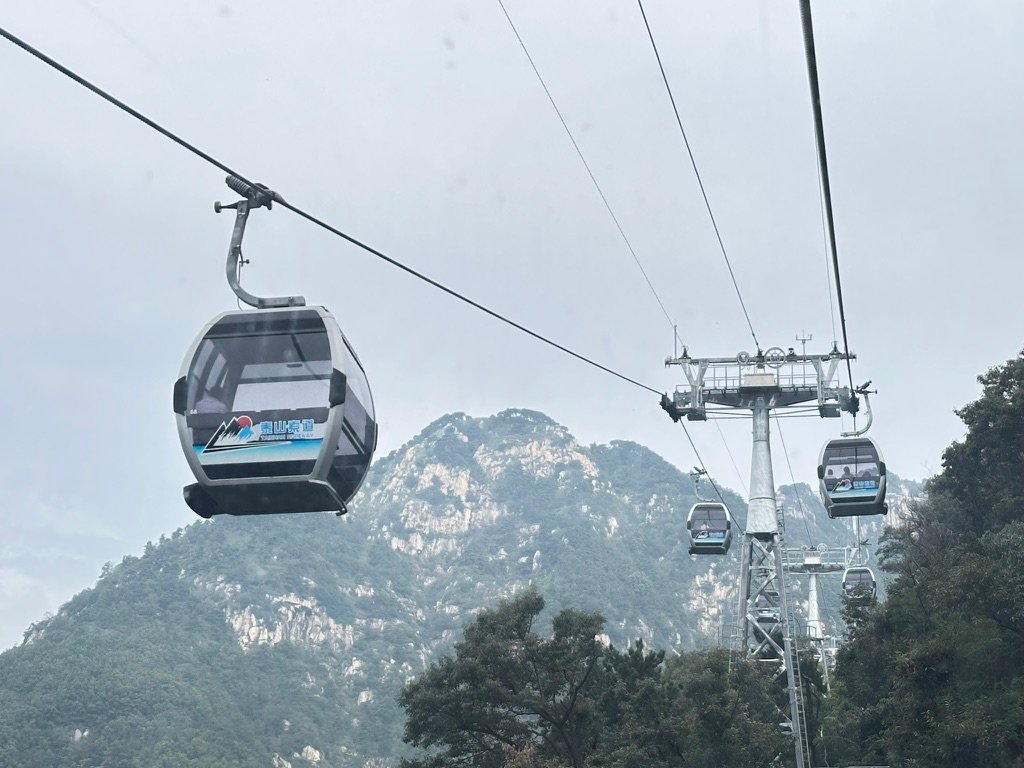
Transport services on the mountain can substantially reduce the amount of climbing.
So:
you do not need to be a serious hiker to experience Mount Tai.
🪜 But the Stairs ARE Part of the Story
If you’re physically comfortable climbing at least part of the traditional route:
do some of it.
Why?
Because Mount Tai isn’t merely:
a summit viewpoint.
The route itself contains:
gates,
temples,
inscriptions,
ancient trees,
ritual spaces
and:
historical layers.
🔥
If you teleport mentally from:
car park
to:
summit selfie
you lose much of:
the mountain as a cultural landscape.
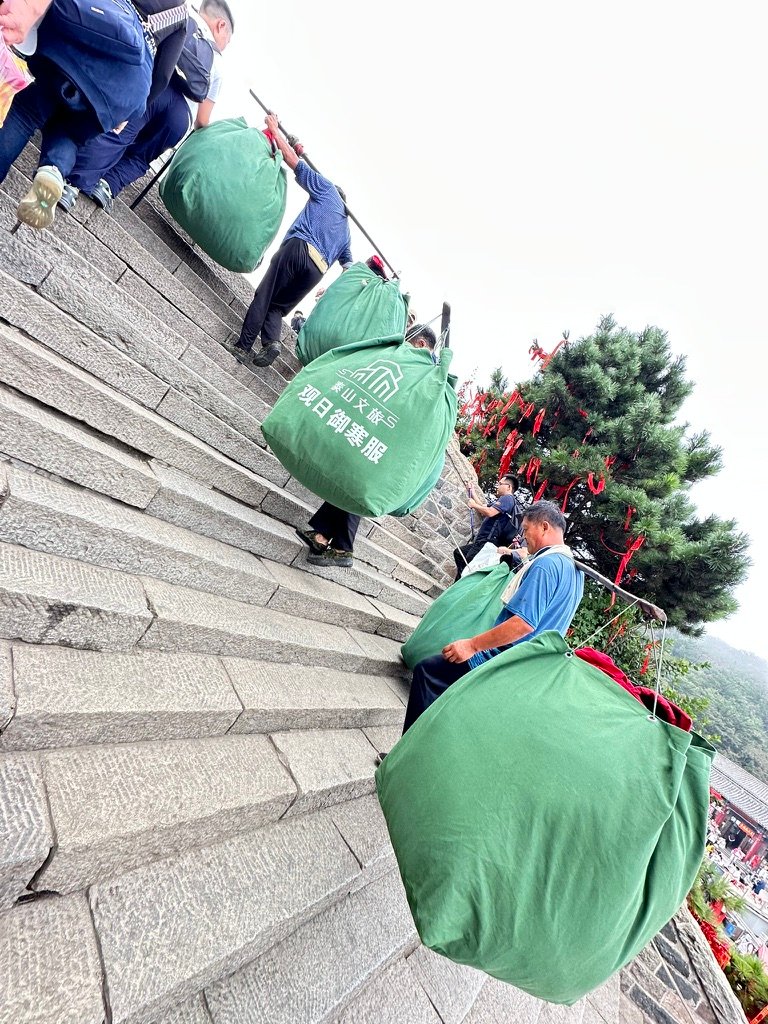
😂 Photo Note: Taishan Has Its Own Supply Chain
Ever wondered how food, drinks and other supplies reach the shops high on Mount Tai (泰山)?
Someone carries them up.
Dad photographed these porters hauling enormous loads up Taishan’s stone stairway using traditional shoulder poles. While tourists struggle with their water bottles and backpacks, these guys are bringing up the mountain’s inventory. 😅
🔥 No delivery van. No loading dock. Just legs, shoulders—and a lot more steps to go.
Photo by Dad on Mount Tai.
One Useful Word: 登
Remember:
登 — dēng
ascend / climb
So:
登山 — dēngshān
climb a mountain
and:
登泰山 — dēng Tàishān
climb Mount Tai
🔥
But historically, people weren’t merely:
登山.
They could also:
祭祀 — jìsì
perform ritual offerings
祈福 — qífú
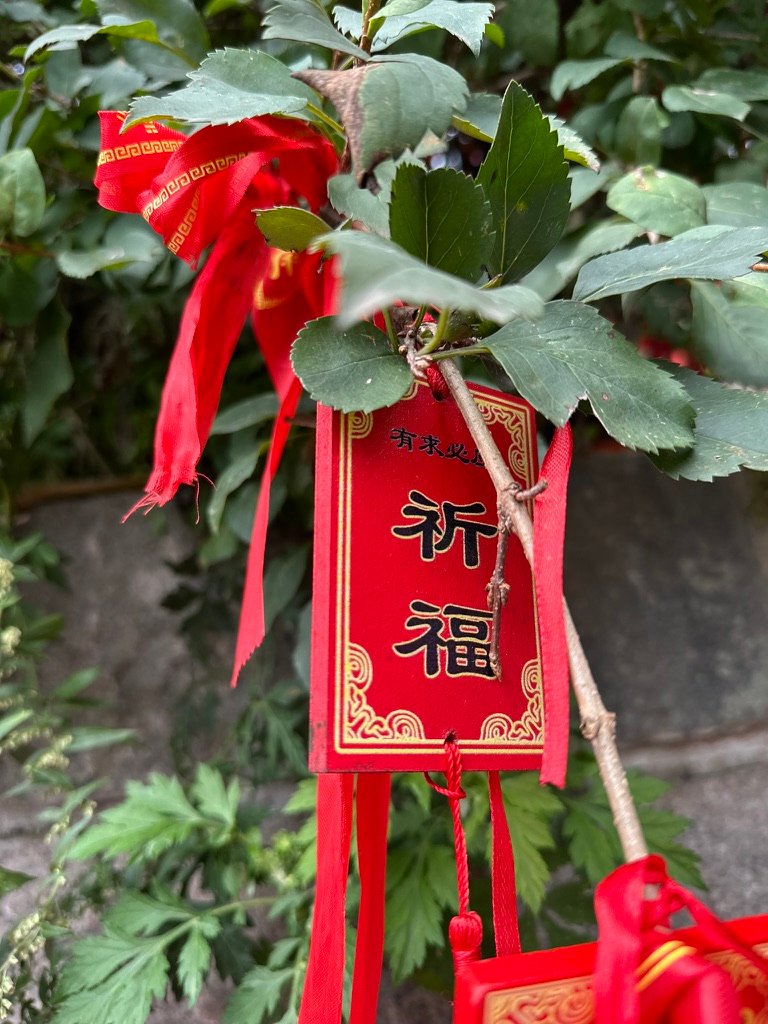
pray for blessings
and:
题字 — tízì
leave inscriptions / calligraphy.
That’s why the route itself matters.
🚶 The Famous Traditional Route
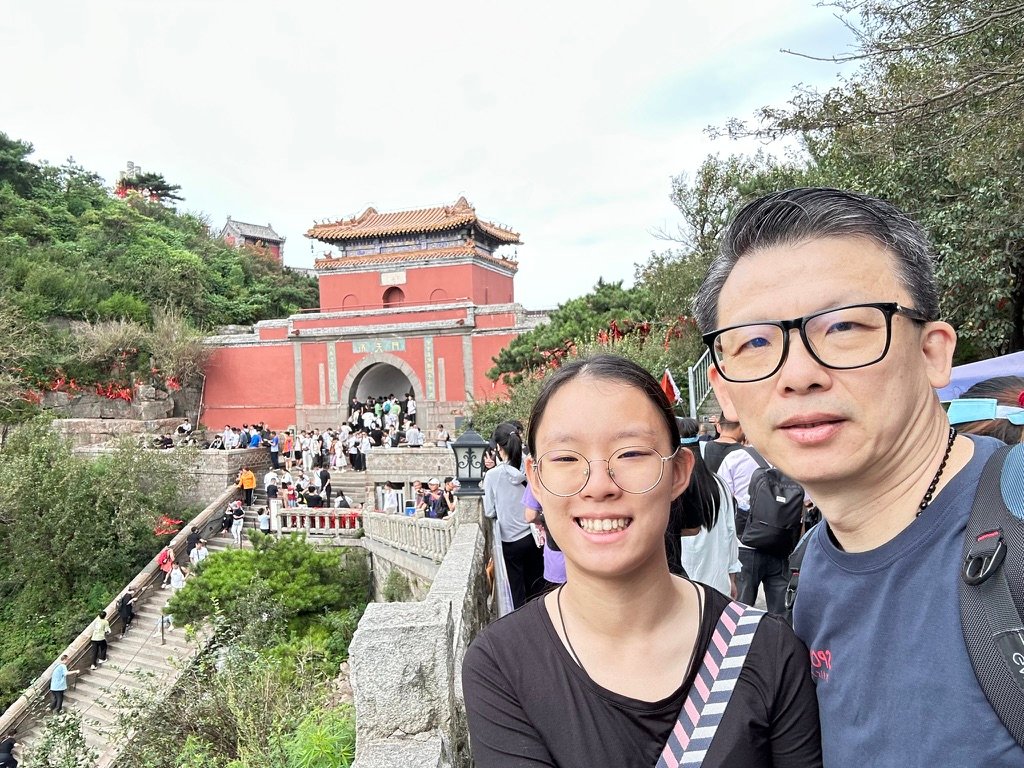
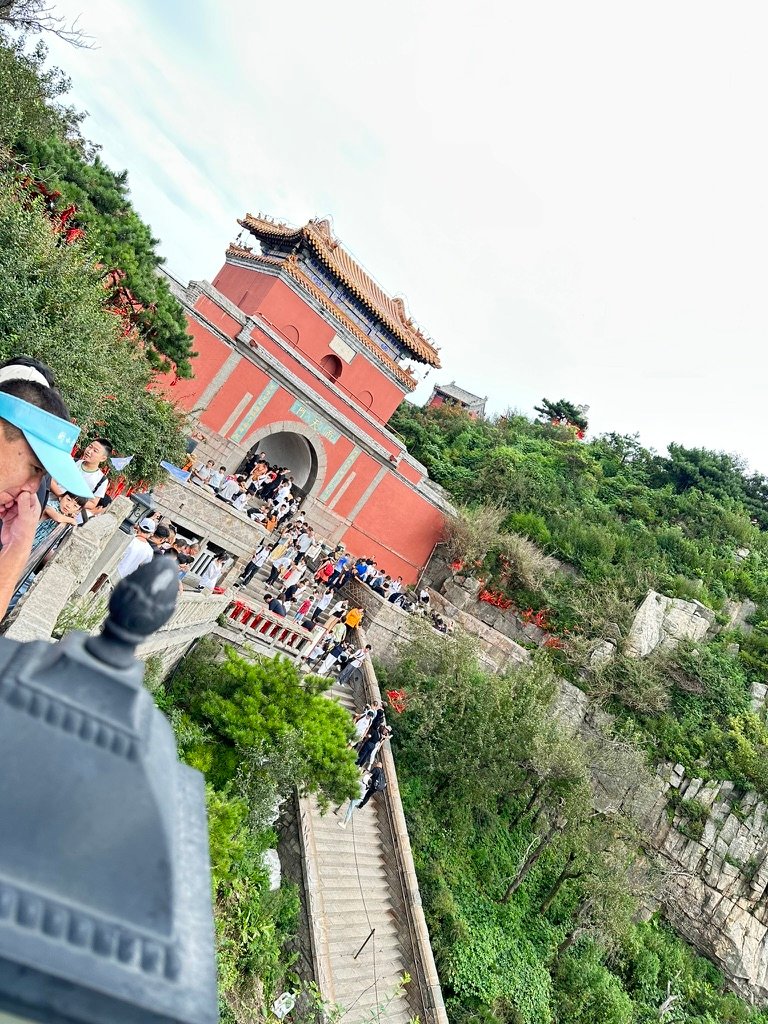
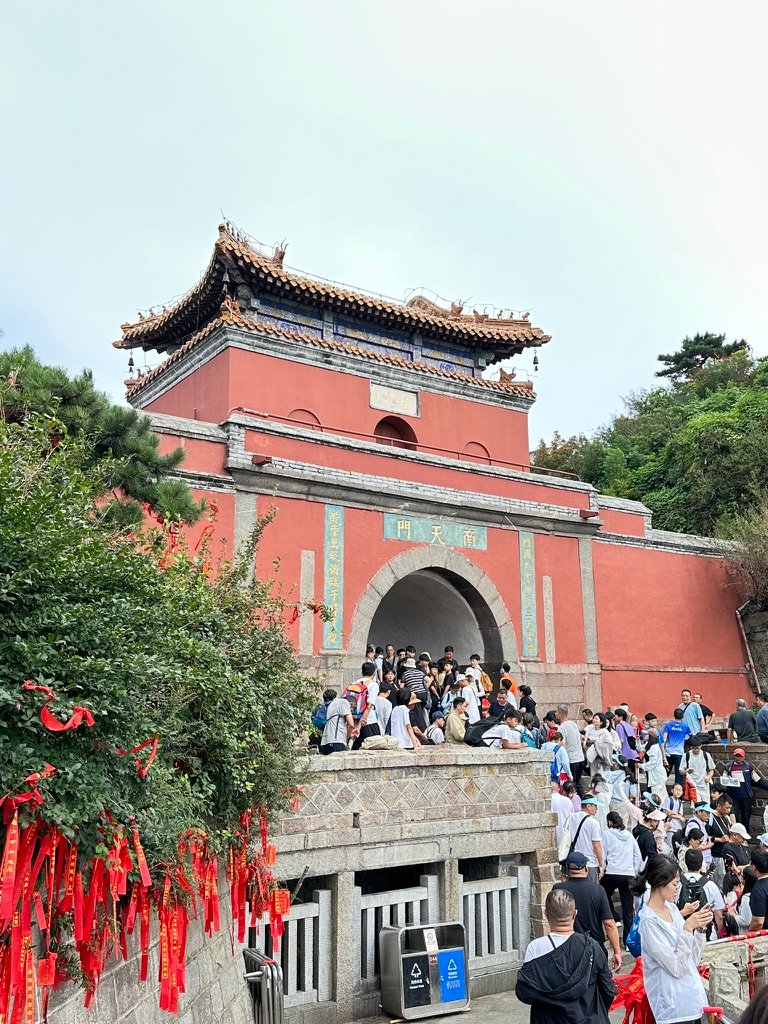
⛰️ Photo Note: Nantianmen 南天门 — The Gate to Heaven
At the top of Taishan’s famous Eighteen Bends (十八盘, Shíbā Pán) stands Nantianmen (南天门, Nántiānmén) — the “South Gate of Heaven.”
The present gate traces its origin to the Yuan dynasty, when the Taoist Zhang Zhichun (张志纯) is traditionally credited with building it in 1264. It was repaired and rebuilt repeatedly in later centuries.
But the name carries a much older idea.
In Chinese religious imagination, 南天门 is the southern gateway into the celestial realm—the entrance to Heaven itself. Putting a “South Gate of Heaven” here transforms the final climb symbolically:
human world below → steep ascent → Nantianmen → sacred summit above.
That is especially fitting on Mount Tai, where emperors performed sacrifices connected with Heaven, Earth and legitimate rule, and where pilgrims have climbed for centuries.
So after struggling up thousands of stone steps, Dad and Elaine weren’t simply approaching another mountain gate.
😂 Taishan was telling us: congratulations—you’ve almost climbed from Earth into Heaven.
BUT still some more steps to reach the summit!
Photo from Dad & Elaine’s Mount Tai climb.
One of the classic approaches follows the historical central route upward toward the summit.
Along the way, the traveler encounters a succession of:
temples,
gates,
stone steps
and:
石刻 — shíkè
rock / stone inscriptions.
🔥
And eventually one famous name begins appearing:
南天门 — Nántiānmén
South Gate of Heaven
Beginner Chinese:
南 — nán
south
天 — tiān
Heaven
门 — mén
gate
So:
南天门
South Gate of Heaven.
😳
After two sections about:
天
you physically climb toward:
a Gate of Heaven.
China occasionally writes the article for us.
😂
🌶️ Don’t Make Sunrise Your Entire Mount Tai Experience
Mount Tai is famous for:
sunrise (日出, rìchū).
Beginner Chinese:
日 — rì
sun
出 — chū
emerge / come out
So:
日出
sunrise.
Beautiful.
Absolutely see it if your itinerary, weather and energy make sense.
🔥
But don’t reduce Mount Tai to:
“Where do I stand for sunrise?”
You would be turning one of China’s great sacred landscapes into:
an Instagram viewing platform.
😂
Sunrise is:
one experience.
The mountain’s historical landscape is:
the bigger experience.
🪨 Dad’s Most Important Taishan Advice: READ THE MOUNTAIN
At Qufu, Dad told you:
read the stones.
At Taishan:
read the mountain.
🔥
Look for:
石刻 — shíkè
rock inscriptions
碑 — bēi
stele
碑文 — bēiwén
stele inscription
题刻 — tíkè
inscribed carving / inscription
The mountain contains inscriptions accumulated across many centuries.
Don’t simply photograph:
beautiful Chinese calligraphy.
Ask:
Who wrote this?
Which dynasty?
What does it say?
Why was THIS statement carved HERE?
🐇
That turns scenery into:
historical evidence.
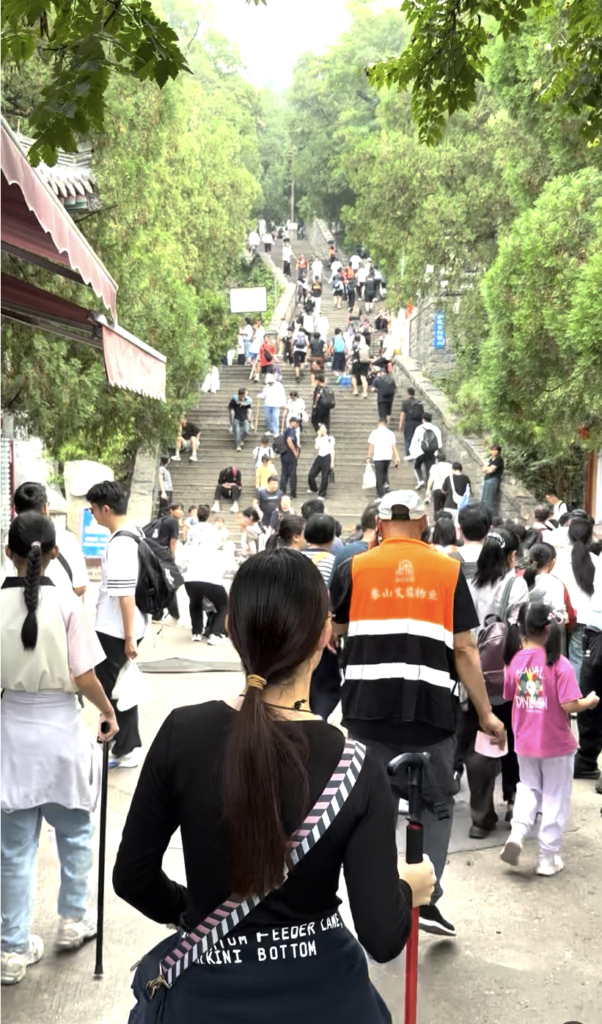
🧑🏫 Dad Recommends a Good English-Speaking History Guide
Can you climb Mount Tai independently?
Absolutely.
For hiking alone, you don’t need somebody following you explaining every tree.
😂
But if this is your:
first serious encounter with Chinese history,
Dad thinks a knowledgeable:
English-speaking guide (英语导游, Yīngyǔ dǎoyóu)
can add enormous value.
Especially if you’re combining:
Taishan + Qufu.
🔥
Because then one guide can help connect:
Mount Tai
→ Heaven
→ imperial ritual
→ legitimacy
with:
Qufu
→ Confucius
→ ritual
→ education
→ government.
Suddenly two tourist attractions become:
one history lesson.
🌶️ Again: Ask for a HISTORY Guide
When booking, don’t simply write:
“English guide for Mount Tai.”
Dad would request:
We are especially interested in Chinese history. We would like an experienced English-speaking licensed guide who can explain Mount Tai’s imperial rituals, fengshan 封禅, the historical inscriptions, the Five Sacred Mountains 五岳, and the connections with Confucianism and Chinese ideas of Heaven 天.
🔥
That tells the tour company:
don’t send Dad a hiking commentator.
😂
We want:
historical interpretation.
🏛️ Don’t Ignore Dai Temple
Before or as part of understanding Mount Tai, pay attention to:
Dai Temple (岱庙, Dàimiào)
in Tai’an.
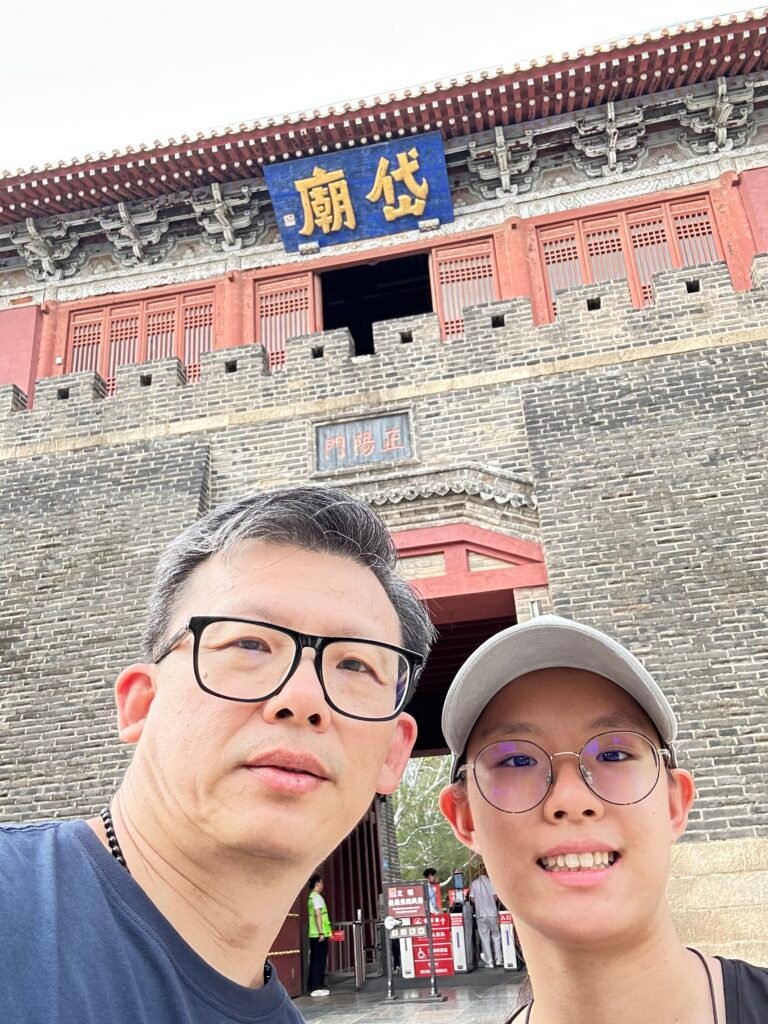
Beginner Chinese:
庙 — miào
temple
Dai Temple is historically connected with worship associated with Mount Tai and imperial ritual.
🔥
If Mount Tai is the:
sacred mountain,
Dai Temple helps reveal:
the institutional ritual world around it.
So don’t think:
“Mountain is the attraction; temple is optional old building.”
They belong to the same historical story.
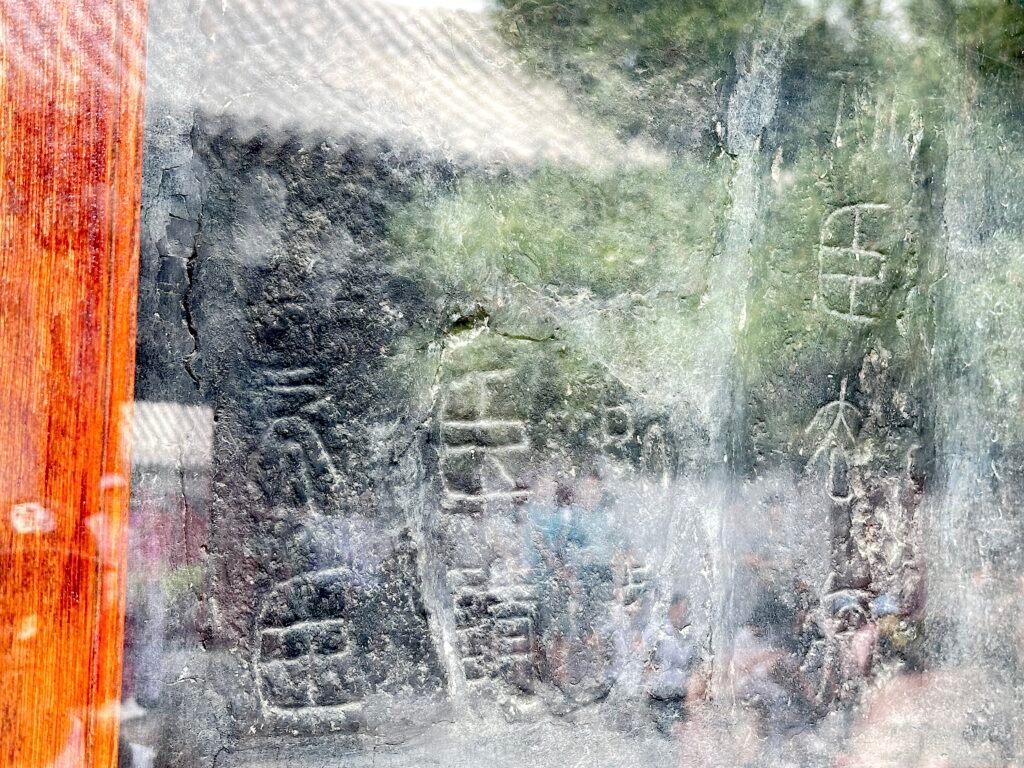
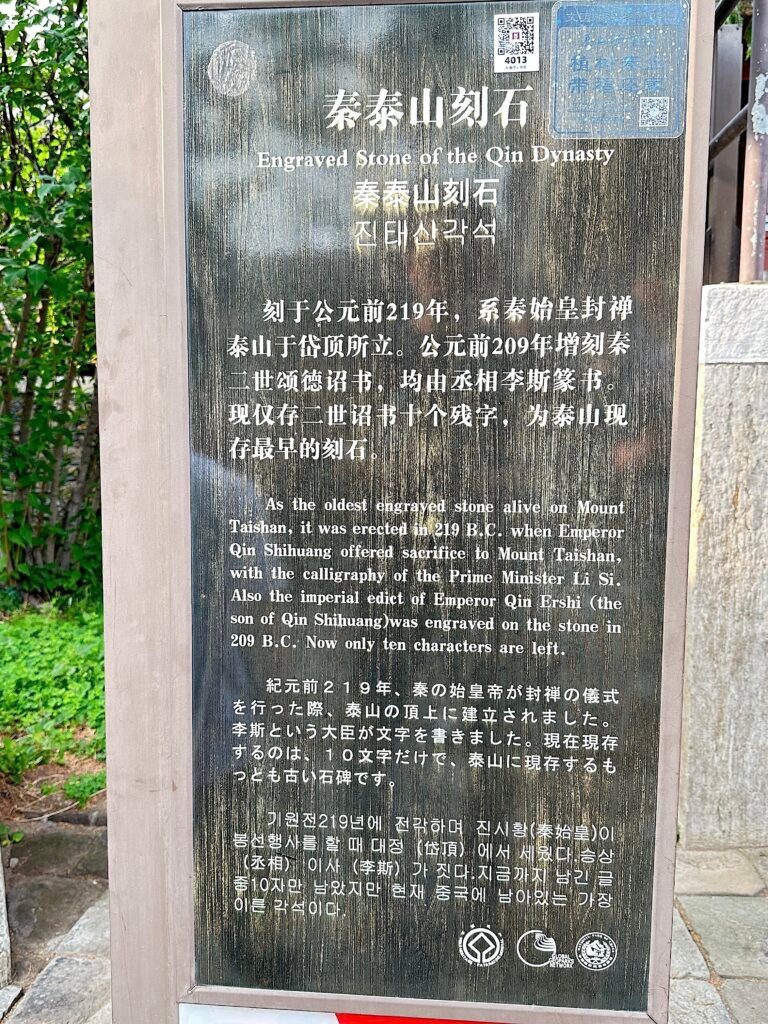
🐞 Photo Note: Qin Shi Huang Left His Words on Mount Tai
Inside Dai Temple (岱庙, Dài Miào) stands one of Mount Tai’s most precious surviving links to Qin Shi Huang (秦始皇).
The 秦泰山刻石 (Qín Tàishān Kèshí) — Qin Mount Tai Inscription was originally erected on Mount Tai in 219 BCE, when Qin Shi Huang came here after unifying China and performed the Fengshan (封禅) rites. The inscription was traditionally attributed to his powerful minister Li Si (李斯), famous for the elegant small-seal script (小篆, xiǎozhuàn)standardized under the Qin.
Ten years later, in 209 BCE, an additional imperial text associated with the Second Qin Emperor was added.
What Dad photographed looks almost disappointingly small today because only ten characters survive.
But think about what you’re looking at:
Qin Shi Huang unified China in 221 BCE.
↓
He climbed Mount Tai in 219 BCE.
↓
His government carved its message into stone.
↓
More than 2,200 years later, fragments of those characters are still here.
🔥 This is why Mount Tai’s stones matter.
They are not merely decorations.
Different rulers literally wrote themselves into the mountain.
And this may be the most extraordinary survivor of all: words from the government of China’s First Emperor, still visible at Dai Temple today.
Photos by Dad at Dai Temple, Mount Tai.
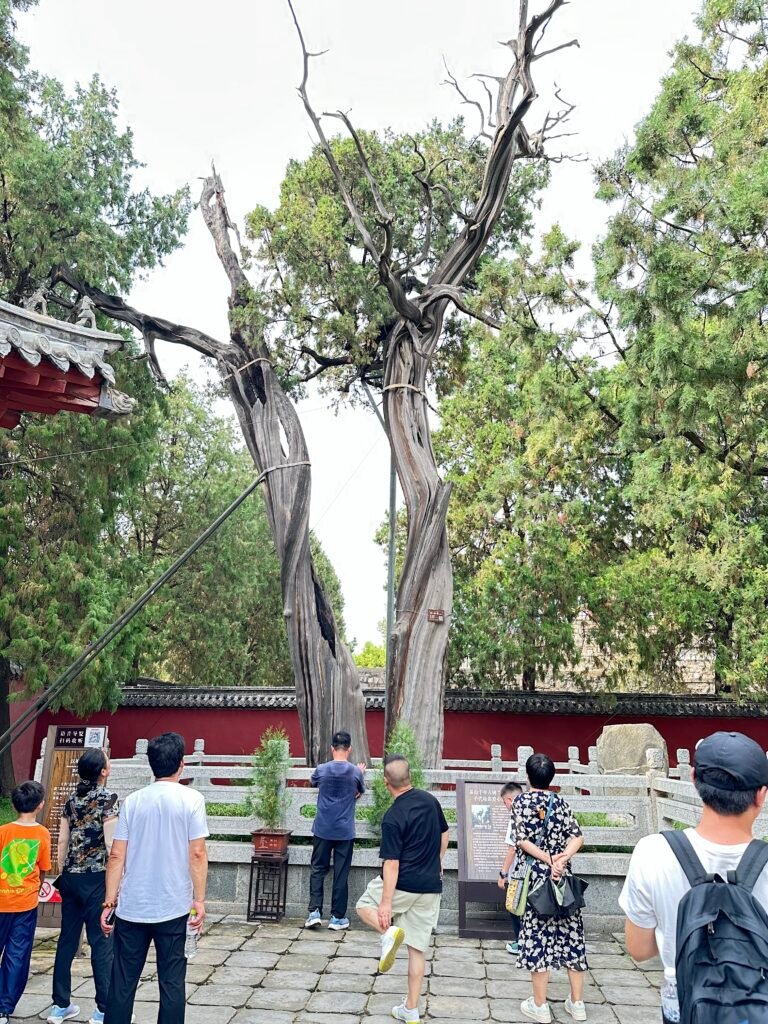
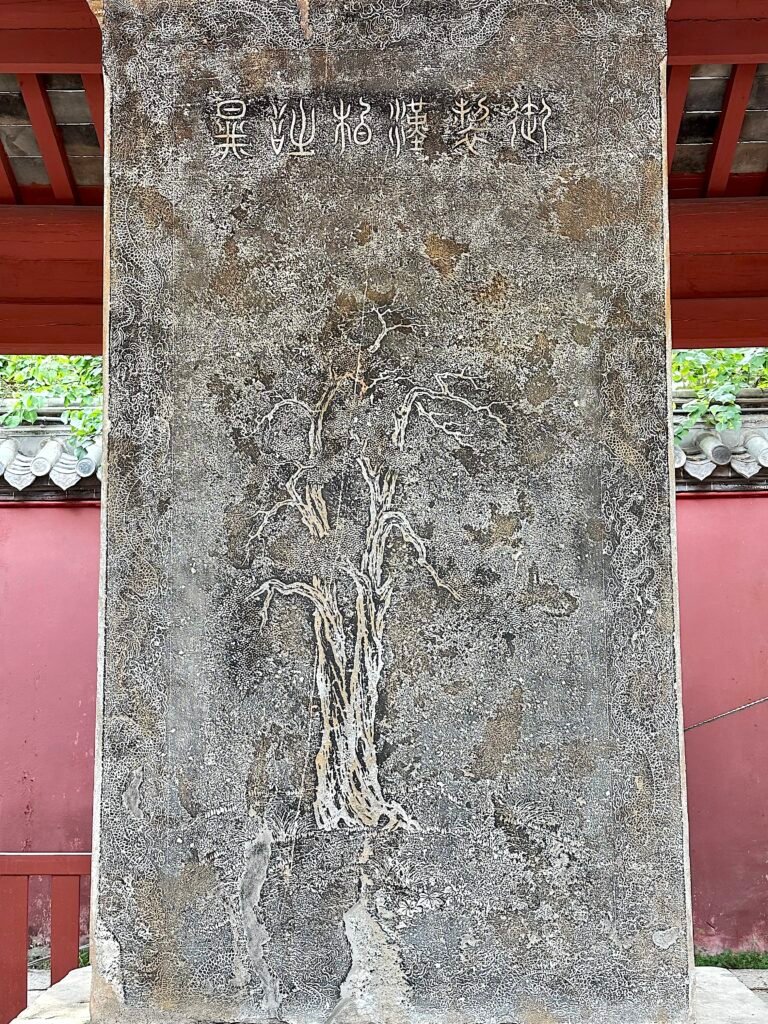
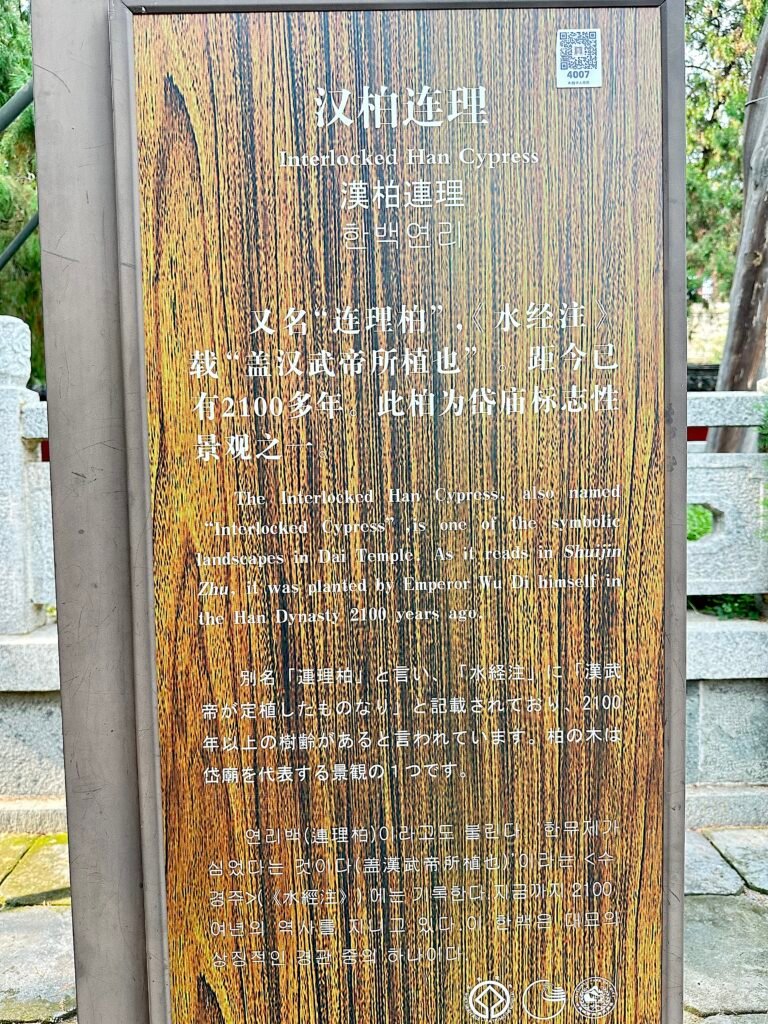
🐞 Photo Note: When an Emperor Drew a 2,000-Year-Old Tree
The stone beside the ancient cypress is not merely an information marker. It is the 御制汉柏图赞碑 (Yùzhì Hàn Bǎi Túzàn Bēi) — an imperial stone engraving associated with the Qianlong Emperor.
When Qianlong visited Dai Temple in 1762, he was so impressed by this ancient Han cypress, traditionally associated with Emperor Wu of Han, that he memorized its unusual twisted form. After returning, he personally drew the tree, and the image was later carved onto this stone. Qianlong also composed poems about it.
So look at Dad’s two photographs together:
the actual ancient tree
→ traditionally linked to Emperor Wu of Han, over 2,000 years ago
the tree carved onto stone
→ drawn by Qianlong, another emperor, nearly 1,800 years later.
🔥 That’s what makes this wonderful.
One emperor was remembered for planting the tree. Another emperor came centuries later and made its portrait. And Dad photographed both.
The official Taishan description confirms that Dai Temple’s Han cypresses were traditionally regarded as planted when Emperor Wu came to Mount Tai, and that Qianlong later painted one and left poetry about it.
Photos by Dad at Dai Temple, Mount Tai.
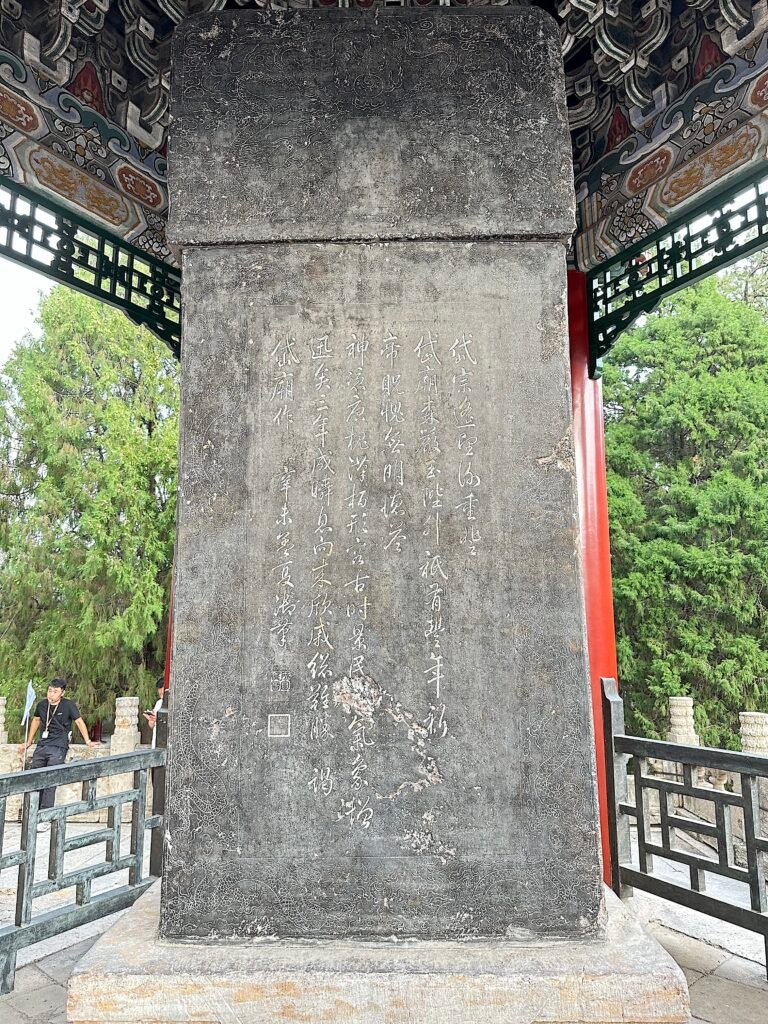
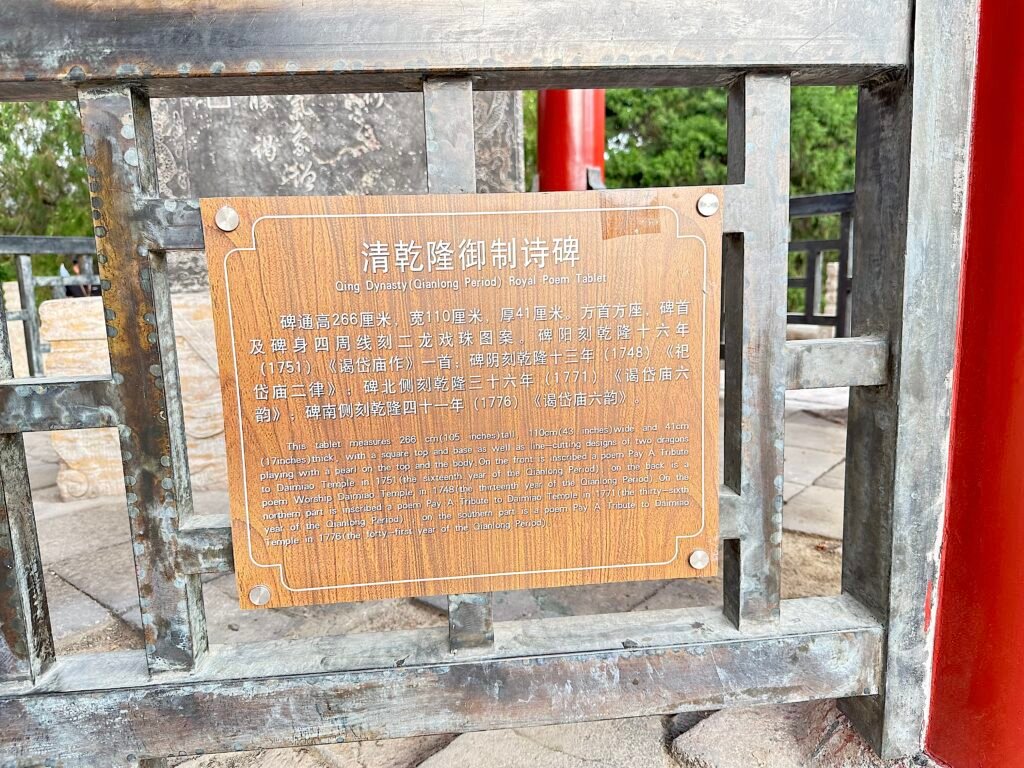
🐞 Photo Note: Qianlong Wasn’t Just an Emperor — He Was an Art Obsessive
This Qianlong imperial poetry stele (清乾隆御制诗碑) at Dai Temple carries poems written during several of the emperor’s visits to Mount Tai. The four faces preserve poems from 1748, 1751, 1771 and 1776. In them Qianlong writes about worship at Dai Temple, ancient cypresses, the mountain landscape—and his hopes for rain, good harvests and the welfare of the people.
But there is another reason this stone is worth noticing.
Qianlong loved art.
He painted, practiced calligraphy, wrote enormous quantities of poetry and—perhaps most famously—became one of history’s great imperial collectors and connoisseurs. Under him, the Qing palace collections of painting, calligraphy, ancient bronzes, jade, ceramics and rare books were studied, catalogued and expanded on an extraordinary scale. The imperial painting-and-calligraphy collection reached unprecedented heights, while Qianlong even ordered ancient bronzes to be measured, illustrated and catalogued systematically.
And Qianlong didn’t leave his artistic interests behind when he traveled. He sometimes carried favorite paintings and calligraphy on his imperial tours, viewed works connected with the places he visited, wrote poems about them and added his own inscriptions.
So this stone at Mount Tai belongs to a much larger Qianlong habit:
see something → study it → write about it → collect it → catalogue it → sometimes leave his own words on it. 😂
Today, enormous parts of the former Qing imperial collections can be encountered in the Palace Museum inside Beijing’s Forbidden City, while another major portion of that historical collection is preserved at the National Palace Museum in Taipei. The Taipei museum’s own exhibitions still contain extraordinary numbers of works associated with Qianlong’s collecting and artistic taste.
🔥 So if you keep seeing 乾隆御笔 — “written by the imperial brush of Qianlong” while traveling around China, don’t be surprised.
Qianlong got around. And he really liked leaving notes. 😂
Photos by Dad at Dai Temple, Mount Tai.
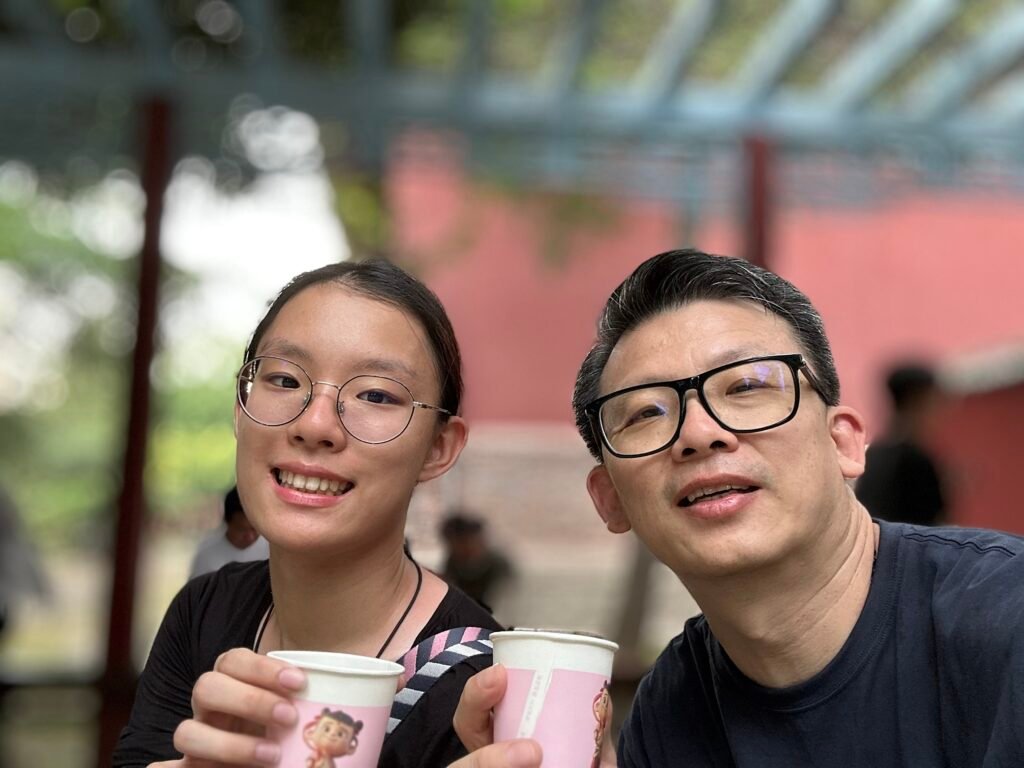
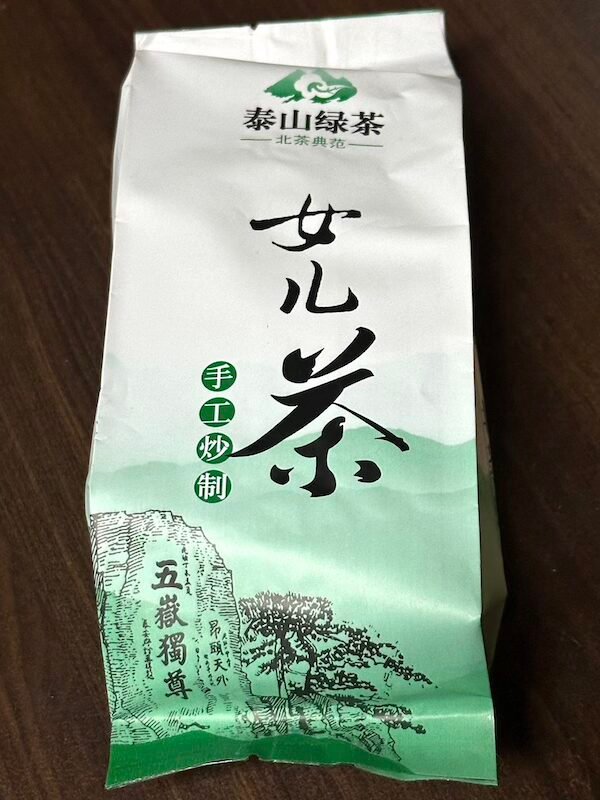
🍵 Photo Note: Journey No. 5 — And Somehow, “Daughter Tea”
By the time we reached Taishan, this was already Dad and Elaine’s fifth journey through China together.
Five journeys of trains, museums, mountains, ancient stones, Dad’s endless historical rabbit holes… and Elaine occasionally wondering how a normal holiday became another open classroom. 😂
Then, at the end of our day at Dai Temple (岱庙), our local guide poured us a local Taishan green tea.
Its name?
女儿茶 (Nǚ’ér Chá) — “Daughter Tea.” ❤️🍵
We looked at each other.
Seriously? On our fifth father–daughter China journey?
It was mild, smooth and so good that we asked our guide to help us buy a packet to bring home.
After climbing Taishan together and spending the day chasing Qin Shi Huang, Emperor Wu, Qianlong, ancient trees and inscriptions, somehow “Daughter Tea” felt like the perfect final cup.
Maybe that’s what these journeys are becoming.
Dad thinks he’s taking his daughter around China to understand its history.
Elaine probably thinks she’s taking Dad around China to make sure he eventually finds the railway station. 😂
Either way, five journeys later, we’re still exploring together.
Dad + Daughter + 女儿茶 + Journey No. 5.
Some souvenirs you drink. The memory comes home with you. ❤️
📸 Dad’s Four-Photo Challenge
Don’t return with:
86 sunrise photographs.
😭😂
Bring home four different Mount Tai stories.
1. THE MOUNTAIN
Landscape.
Scale.
The Shandong plain below.
2. THE WORDS
Photograph:
石刻.
Chinese characters carved into the mountain.
3. THE RITUAL
Temple.
Gate.
Sacred space.
Something showing that Taishan isn’t merely nature.
4. THE HUMAN JOURNEY
Dad.
Elaine.
Guide.
Stairs.
Exhausted face.
😂
Something showing:
you actually traveled through the history.
Eight Chinese Words Worth Bringing Home
For our HSK beginners:
泰山 — Tàishān
Mount Tai
山 — shān
mountain
登 — dēng
ascend / climb
天 — tiān
Heaven
天子 — Tiānzǐ
Son of Heaven
天命 — Tiānmìng
Mandate of Heaven
祭祀 — jìsì
ritual sacrifice / ceremonial offering
封禅 — fēngshàn
the exceptional imperial rites associated especially with Mount Tai
And bonus:
石刻 — shíkè
stone / rock inscription.
🔥
If you remember those words, Mount Tai already looks different.

🐞 Now You’re Ready for the Sting
Before leaving:
泰山,
Dad wants you to carry away:
three questions.
Not the exact number of stairs.
😂
Three questions.
🐇 QUESTION 1 — Why Did Emperors Need Heaven?
You now know:
天 — Heaven
天子 — Son of Heaven
天命 — Mandate of Heaven
and:
天下 — All Under Heaven.
So ask:
Why did Chinese political legitimacy become so deeply connected with Heaven?
🔥
That takes us directly into the:
Deep China Big Questions
Michelin course on:
Heaven, the emperor and Chinese political order.
🐇 QUESTION 2 — Could Heaven Fire the Emperor?
😂
If Heaven can give:
天命 — the Mandate of Heaven,
can the mandate be:
lost?
Then what do:
floods (洪水),
droughts (旱灾),
rebellions (起义, qǐyì),
defeat
and:
dynastic collapse
mean?
🔥
Now Taishan has connected:
cosmology
with:
revolution and dynastic change.
That’s a rather large rabbit for one mountain.
🐇
🐇 QUESTION 3 — Why Does Confucius Keep Appearing Nearby?
Taishan sits in:
Shandong.
So does:
Qufu.
And Confucius belongs to this broader historical landscape.
Now:
天 — Heaven
at Taishan
meets:
礼 — ritual/propriety
at Qufu.
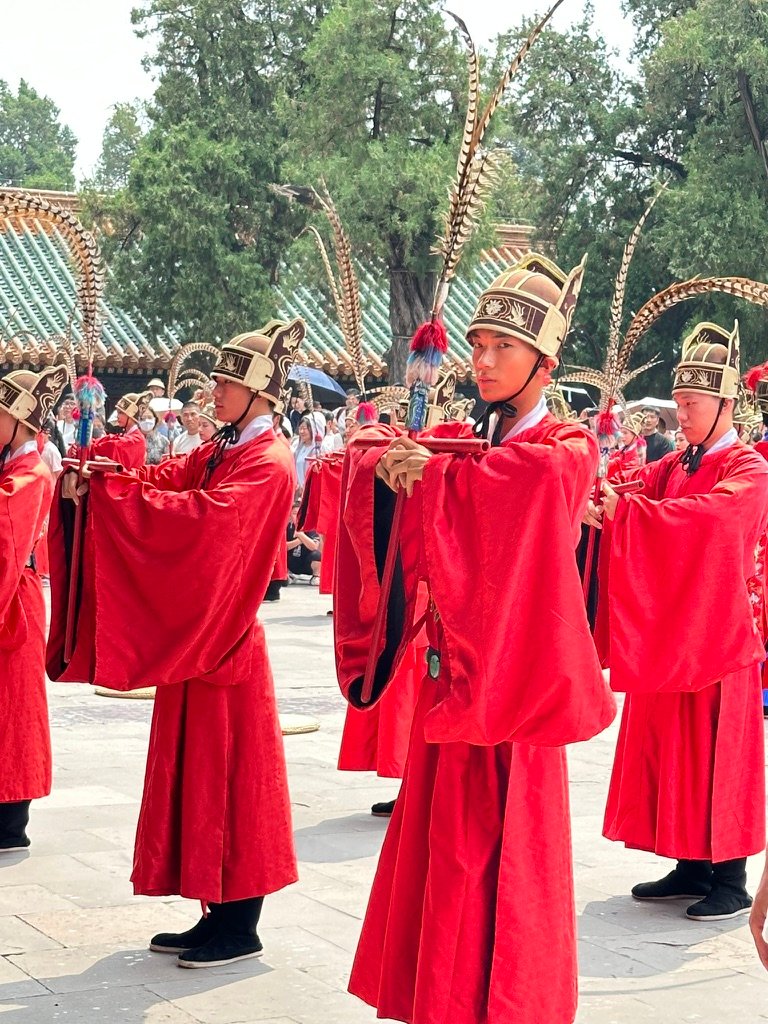
What does 礼 (lǐ) actually look like? A ceremonial performance at the Temple of Confucius in Qufu gives visitors a vivid visual doorway into the world of 礼 — ritual, propriety and ordered conduct that became so important in the Confucian tradition. The costumes and choreography are modern presentation, but the bigger idea is ancient: ritual was not merely ceremony—it helped express relationships, hierarchy and social order. Photo by Dad.
😳
One helps us understand:
imperial legitimacy.
The other helps us understand:
social and political order.
That’s why our Shandong journey should not stop at Mount Tai.
🍽️ Ready to Go Michelin?
You’ve now tasted enough Taishan fried rice.
😂
The mountain has already given you:
天
天命
天子
天下
and:
封禅.
So now go to the Big Question:
Why Does Chinese History Keep Talking About Heaven?
There we’ll connect:
↓
Mandate of Heaven (天命)
↓
Son of Heaven (天子)
↓
Mount Tai (泰山)
↓
Temple of Heaven (天坛)
↓
and even the awkward question:
What happens when a Mongol or Manchu ruler becomes China’s Son of Heaven?
😬🐇🔥
That’s the Michelin course.
🐇 Continue the Shandong Journey
But geographically, don’t leave Shandong yet.
Your next plate should be:
Qufu (曲阜).
There Dad & Elaine encountered:
Confucius (孔子)
仁 — humaneness
礼 — ritual
儒家 — Confucian tradition
and:
碑 — steles
that help reveal how one teacher’s ideas became embedded in institutions across later Chinese history.
🔥
So:
TAISHAN
asks:
Why does the emperor need Heaven?
Then:
QUFU
asks:
How do ideas and ritual help a state govern?
Now you’re not sightseeing.
You’re building the coat rack.
🐞 ChinaTravelBUG’s Take
Go to Mount Tai because:
it’s beautiful.
Climb if you want.
Take the cable car if that makes more sense for you.
See:
日出 — sunrise
if the weather cooperates.
Take the photograph.
🔥
But don’t leave remembering only:
“That was a lot of stairs.”
😂
Look at:
the temples.
Read:
the stones.
Learn:
天.
Ask why:
Qin Shi Huang
and:
Han Wudi
wanted their imperial achievements connected with this mountain.
Then remember the:
Temple of Heaven
you probably already photographed in Beijing.
😳
Suddenly:
Beijing
and:
Taishan
are talking to each other.
One shows you:
imperial ritual in the capital.
The other takes you into:
an older sacred landscape where emperors connected political achievement with Heaven and Earth.
🔥
That’s why Mount Tai belongs on a:
Beyond Beijing
journey.
Not because you need:
another UNESCO site
on your checklist.
But because after Mount Tai:
the word 天 will never look quite the same again.
🐞🐇🔥
Travel China. Let the places teach you Chinese history.
See the place. Ask the bigger question. Understand China better.