
Section 1 — Before Zhou Won, King Wen Was a Prisoner of Shang
Dad & Elaine had just encountered the world of the:
Shang dynasty (商朝, Shāng Cháo)
at:
Yinxu (殷墟, Yīnxū)
near Anyang (安阳, Ānyáng) in Henan Province (河南省, Hénán Shěng).
There, Shang felt powerful.
Royal tombs.
Bronzes.
Palace and temple remains.
Oracle bones carrying the questions and names of Shang kings.
🔥
Then we went to another historical site near Anyang:
Youlicheng (羑里城, Yǒulǐchéng).
And suddenly Dad found himself looking at the same historical transition from:
THE OTHER SIDE.
Because Youlicheng is traditionally associated not with the dynasty that was ruling…
but with:
THE FAMILY THAT WOULD REPLACE IT.
👑 Meet Ji Chang 姬昌— Before He Became King Wen
His name was:
Ji Chang (姬昌, Jī Chāng).
Later generations would know him as:
King Wen of Zhou (周文王, Zhōu Wénwáng).
Today, that name sounds enormous.
One of the great founding figures of the Zhou tradition.
Father of:
King Wu of Zhou (周武王, Zhōu Wǔwáng).
Ancestor of the dynasty that would replace Shang.
But Dad wants you to forget the ending for a moment.
😂
Because when Ji Chang was associated with Youli:
THERE WAS NO ZHOU DYNASTY YET.
SHANG STILL RULED.
🧥 Dad’s Coat Rack: Where Are We in Chinese History?
Before we go further, let’s put some dates on the wall.
Because:
Shang → Zhou
looks wonderfully simple in a history book.
😂
But we’re standing more than:
3,000 YEARS AGO.
For an international traveler, here’s the only timeline you need.
c. 1600–1046 BCE
Shang dynasty (商朝, Shāng Cháo)
The Shang ruled for several centuries.
The late Shang royal capital at:
Yinxu (殷墟, Yīnxū)
near Anyang gives us extraordinary archaeological evidence of this world:
royal tombs,
bronzes,
palace and temple foundations
and:
oracle-bone inscriptions (甲骨文, jiǎgǔwén).
These inscriptions belong especially to the last centuries of Shang rule.
🔥
So when Dad & Elaine visited Yinxu, we were looking at the world of:
LATE SHANG.
c. 12th–11th century BCE
Ji Chang (姬昌, Jī Chāng) — the future King Wen of Zhou
This is approximately the historical neighborhood of our Youlicheng story.
Ji Chang was the leader of the rising:
Zhou (周, Zhōu)
power in the west.
Later generations knew him as:
King Wen of Zhou (周文王, Zhōu Wénwáng).
According to transmitted historical tradition, Ji Chang was detained at:
Youli (羑里, Yǒulǐ)
by:
King Zhou of Shang (商纣王, Shāng Zhòuwáng).
⚠️ We should resist giving Ji Chang’s confinement a precise modern calendar year.
The tradition is ancient.
The exact chronology is not secure enough for Dad to write:
“Ji Chang entered prison in XXXX BCE.”
😂
What matters for our coat rack is:
SHANG STILL RULED.
ZHOU HAD NOT YET BECOME THE RULING DYNASTY.
c. 1046 BCE
Battle of Muye (牧野之战, Mùyě Zhī Zhàn)
Ji Chang did not live to see the final overthrow of Shang.
His son:
King Wu of Zhou (周武王, Zhōu Wǔwáng)
led the Zhou forces against the last Shang king.
At the:
Battle of Muye
around:
1046 BCE,
Shang power was defeated.
🔥
This is the great political turning point:
SHANG 商
↓
ZHOU 周
c. 1046–771 BCE
Western Zhou (西周, Xī Zhōu)
The Zhou ruling house now established a new political order.
This is the world that will later lead us toward:
King Wu (周武王),
Duke of Zhou (周公, Zhōugōng),
Zhouyuan (周原, Zhōuyuán),
and eventually:
the Mandate of Heaven (天命, Tiānmìng).
🐇
Dad & Elaine have followed those rabbits elsewhere.
But at Youlicheng:
NONE OF THAT HAS HAPPENED YET.
So Where Are We Standing?
Keep only this:
c. 1600 BCE
Shang dynasty begins
↓
LATE SHANG — 11th century BCE
Shang still rules
↓
JI CHANG 姬昌
leader of the rising Zhou power
↓
DETAINED AT YOULI 羑里
according to transmitted historical tradition
↓
JI CHANG 姬昌 DIES
later remembered as King Wen 周文王
↓
c. 1046 BCE
Battle of Muye 牧野之战
↓
SHANG FALLS
↓
WESTERN ZHOU 西周
c. 1046–771 BCE
🔥
And here’s the most important thing to remember:
Youlicheng belongs to the BEFORE.
Before Zhou became the dynasty.
Before King Wu defeated Shang.
Before the Zhou political order.
Before the Mandate of Heaven became one of the great ideas of Chinese political history.
At Youlicheng, the future:
ISN’T HISTORY YET.
Ji Chang is still living under:
SHANG RULE.
😳
That’s what makes this place so interesting.
Why Was Ji Chang 姬昌 Detained?
Traditional accounts describe Ji Chang as an increasingly important western leader within the Shang political world.
As Zhou power and Ji Chang’s reputation grew, the relationship with the Shang court became politically dangerous.
Later historical tradition records that:
King Zhou of Shang (商纣王, Shāng Zhòuwáng)
detained Ji Chang at:
Youli 羑里.
Exactly how we reconstruct these events more than 3,000 years later requires caution.
But the political situation is easy to understand:
A POWERFUL RULER
has reason to worry about:
A RISING REGIONAL POWER.
🔥
And suddenly the future founder isn’t standing triumphantly on a pedestal.
He’s:
UNDER THE OLD REGIME’S CONTROL.

Dad’s Photo — Youlicheng (羑里城, Yǒulǐchéng), Henan: This weathered stone carries a remarkable reminder of how long King Wen of Zhou (周文王) remained part of China’s historical memory. The information board dates the imperial commemoration to 1539, during the Ming dynasty’s Jiajing reign, more than 2,500 years after King Wen’s era. It also repeats the traditional story that while confined at Youli, King Wen developed the Changes (易, Yì) — the tradition later associated with the Yijing (《易经》, Book of Changes). Standing here, Dad wasn’t just looking at the story of a Zhou prisoner, but at how later generations of China continued to remember him.
Western Handrail: History Makes the Winner Look Inevitable
This is a trap in almost every civilization’s history.
Once we know:
WHO WON,
we unconsciously read backward as though victory was always going to happen.
😂
The Roman Empire feels inevitable after Rome wins.
A successful revolution feels inevitable after the old regime falls.
A famous founding dynasty feels inevitable after historians put it neatly onto a timeline.
But the people living through those moments:
DIDN’T KNOW THE ENDING.
🔥
At Youlicheng, try to forget that Zhou eventually wins.
Ji Chang doesn’t know:
“Don’t worry. Your son will defeat Shang and your family will become one of the most influential dynasties in Chinese history.”
😂
He’s living inside:
AN UNCERTAIN PRESENT.
That’s the Western handrail.
🐇 Yinxu 殷墟 and Youlicheng 羑里城 — Two Sides of One Transition
This is why Dad thinks the two places work beautifully together.
At:
YINXU 殷墟
we encounter:
SHANG FROM INSIDE SHANG.
Its kings.
Its ancestors.
Its bronzes.
Its royal rituals.
Its writing.
Its political center.
Then at:
YOULICHENG 羑里城
we encounter:
THE FUTURE ZHOU WHILE SHANG STILL RULES.
🔥
One journey gives us:
THE ESTABLISHED POWER.
The other:
THE RISING CHALLENGER.
Now:
“Shang → Zhou”
stops looking like two boxes on Dad’s timeline.
It becomes:
A POLITICAL TRANSITION BETWEEN REAL RIVALS.
And Zhou Wasn’t Yet “China’s Next Dynasty”
This distinction is worth keeping.
We know the later textbook sequence:
SHANG
↓
ZHOU
↓
QIN
↓
HAN
Easy.
Too easy.
😂
Ji Chang did not live inside a chapter titled:
“The End of Shang and Rise of Zhou.”
He lived within a political world of:
regional powers,
alliances,
rivalries,
kinship,
military strength
and:
Shang royal authority.
Zhou had to:
BECOME ZHOU.
That process took time.
And Youlicheng belongs to that:
BEFORE.
Deep China Evidence Sign
Now Dad puts up the familiar sign.
😂
The association between:
Ji Chang 姬昌
and his confinement at:
Youli 羑里城
belongs to China’s transmitted historical tradition.
The Youlicheng visitors experience today is a:
LATER HISTORICAL AND COMMEMORATIVE LANDSCAPE.
We should not walk around saying:
“This exact wall is the original prison wall King Wen touched 3,000 years ago.”
unless specific archaeological evidence supports that claim.
🔥
Keep the layers separate:
TRANSMITTED HISTORY
ARCHAEOLOGY
TRADITION
LATER COMMEMORATION
They can all help us understand the past.
But they don’t all tell us:
THE SAME THING.
And Yet Youlicheng 羑里城 Has Another Story
If Ji Chang’s story ended with:
“Future Zhou leader detained by Shang,”
Youlicheng would already be worth understanding.
But Chinese cultural memory attaches another extraordinary tradition to his confinement here.
While detained, King Wen became associated with the development of:
《周易》 — Zhōuyì
Changes of Zhou
which later became part of the classical tradition known as:
《易经》 — Yìjīng
Classic of Changes / I Ching.

Dad’s Photo — Youlicheng (羑里城, Yǒulǐchéng), Henan: This sign marks the Yanyi Platform (演易台, Yǎnyì Tái), where, according to the tradition presented at Youlicheng, King Wen of Zhou (周文王) developed the Eight Trigrams (八卦, Bāguà) associated with Fuxi into the 64 hexagrams while imprisoned here. Those 64 hexagrams became central to the tradition of the Yijing (《易经》, Yìjīng — Book of Changes). The story is one of the reasons Youlicheng is remembered not simply as King Wen’s place of confinement, but as a place where imprisonment became associated with one of China’s most influential intellectual traditions.
🎥 Dad at Youlicheng (羑里城, Yǒulǐchéng) — Why This Place Moved Him
After nearly two hours exploring Youlicheng (羑里城, Yǒulǐchéng), Dad stopped beneath a pavilion.
Elaine held the camera.
Cheers joined us too.
😂
Dad was standing at a place traditionally associated with the detention of:
King Wen of Zhou (周文王, Zhōu Wénwáng)
— then known as Ji Chang (姬昌, Jī Chāng) — while the Shang dynasty (商朝, Shāngcháo) still ruled.
Chinese cultural tradition also connects King Wen’s confinement here with:
《周易》
Zhōuyì
“Changes of Zhou”
and the later:
《易经》
Yìjīng
Book of Changes / I Ching.
For Dad, bringing Elaine here made that 3,000-year-old story suddenly feel much less distant.
🔥
🐇 Why Dad’s Emotion Actually Matters
Dad wasn’t emotional because we had proven:
“The I Ching was written right here.”
We hadn’t.
He was emotional because Dad & Elaine were standing in a place where Chinese cultural memory connects:
KING WEN (周文王)
↓
CONFINEMENT
↓
《周易》 (Zhōuyì)
↓
《易经》 (Yìjīng)
↓
thousands of years of Chinese thought.
That distinction matters.
HISTORY asks what we can establish.
CULTURAL MEMORY asks why people kept remembering the story.
At Youlicheng:
BOTH ARE WORTH ASKING.
🐇
And this is where our political rabbit suddenly becomes:
AN INTELLECTUAL RABBIT.
Because the Changes would eventually be honored in Chinese tradition as:
群经之首 — qún jīng zhī shǒu
“the foremost of the Classics.”
😳
How does a story about:
A PRISONER UNDER SHANG
lead us toward:
ONE OF CHINA’S MOST INFLUENTIAL PHILOSOPHICAL CLASSICS?
To understand that…
Dad needs Western readers to forget the 64 hexagrams for a moment.
😂
Start somewhere much easier.
Look at:
THE SUN AND MOON.
DAY AND NIGHT.
GROWTH AND DECLINE.
CHANGE.
And meet:
阴 and 阳.
Section 2 — King Wen and the Changes: From Yin and Yang to the Eight Trigrams
At Youlicheng, the political story gives us an unexpected intellectual rabbit.
Chinese tradition connects:
King Wen of Zhou (周文王, Zhōu Wénwáng)
with the development of:
《周易》 — Zhōuyì
Changes of Zhou
But before Western readers meet:
八卦
or:
六十四卦
Dad wants to start somewhere much easier.
😂
LOOK AT NATURE.
🌞🌙 A World That Never Stops Changing
Watch:
DAY → NIGHT
The sun rises.
Reaches its height.
Descends.
Then darkness comes.
But darkness doesn’t remain forever.
Morning returns.
Look at the moon:
WAXING → FULL → WANING → NEW → WAXING AGAIN
Look at the seasons:
SPRING → SUMMER → AUTUMN → WINTER → SPRING
🔥
Nature doesn’t sit still.
It moves.
Changes.
Reverses.
Returns.
And Chinese thinkers developed one of their most influential ways of describing these relationships through:
阴阳 — yīnyáng
yin and yang
☯️ Yin and Yang Are Not Good and Evil
For a beginner, traditional associations include:
阳 — yáng
sun • light • day • warmth • activity • traditionally male
and:
阴 — yīn
moon • shade • night • coolness • rest • traditionally female
But here’s the important part:
YANG ≠ GOOD
and:
YIN ≠ EVIL.
😂
Don’t think:
GOOD ↔ BAD.
Think:
DAY ↔ NIGHT.
Night isn’t an enemy that day needs to defeat.
Both belong to:
ONE CHANGING RELATIONSHIP.
🧠 阴中有阳,阳中有阴
And Dad thinks this is where yin and yang become much more interesting:
阴中有阳,阳中有阴
Yīn zhōng yǒu yáng, yáng zhōng yǒu yīn
Very simply:
WITHIN YIN, THERE IS YANG.
WITHIN YANG, THERE IS YIN.
🔥
Don’t imagine two completely sealed boxes:
YIN | YANG
Instead think:
RELATIONSHIP.
INTERDEPENDENCE.
PROPORTION.
TRANSFORMATION.
One tendency may be stronger at a particular moment without the other being completely absent.
🪜 Modern Handrail: Male and Female Hormones
Here’s a modern analogy Dad likes.
We often associate:
TESTOSTERONE → MALE
and:
ESTROGEN → FEMALE.
But actual human biology isn’t:
Male = testosterone only. Female = estrogen only.
😂
Both males and females normally have:
ANDROGENS
and:
ESTROGENS
in different concentrations and physiological patterns.
One may predominate without the other being:
ABSENT.
🔥
That’s a useful modern handrail for:
阴中有阳,阳中有阴.
Important:
Ancient Chinese thinkers were obviously NOT describing modern endocrinology.
😂
The hormone example is only a handrail for:
PREDOMINANCE WITHOUT ABSOLUTE EXCLUSION.
Then get off the bridge.
🌞 Noon Already Contains the Journey Toward Night
Nature gives us an even better example.
At noon:
LIGHT APPEARS STRONGEST.
But once the sun reaches its highest point…
what happens?
IT BEGINS TO DESCEND.
😳
The moment of greatest daylight already contains movement toward:
NIGHT.
And at the darkest part of night?
DAWN IS APPROACHING.
🔥
So don’t ask only:
“Is this yin or yang?”
Ask:
“WHAT CHANGE IS ALREADY DEVELOPING INSIDE IT?”
That’s much closer to the way Dad wants Western readers to approach the Changes.
🌕 Fullness Already Contains Change
The moon reaches:
FULLNESS.
Then begins:
WANING.
Winter reaches its depth.
Then movement toward:
SPRING
begins.
This helps us understand two familiar Chinese expressions:
周而复始 — zhōu ér fù shǐ
a cycle completes and begins again
and:
物极必反 — wù jí bì fǎn
when something reaches an extreme, it tends toward reversal
🔥
The point isn’t:
“Everything repeats mechanically forever.”
It is the habit of looking at:
PROCESS.
CYCLES.
LIMITS.
and:
TRANSFORMATION.

Western Handrail: Don’t Think Light Switch — Think Sunrise
A light switch gives us:
ON / OFF.
Click.
One disappears.
The other appears.
😂
That’s a poor handrail.
Think:
DAWN → NOON → SUNSET → NIGHT → DAWN
One tendency grows.
Another recedes.
Then the relationship changes again.
So:
阴阳
isn’t primarily about:
STATIC OPPOSITES.
It’s about:
DYNAMIC RELATIONSHIPS.
☯️ Now the Lines Begin to Make Sense
Once we have that idea, two simple lines become much easier to understand:
⚊
associated with yang
and:
⚋
associated with yin
Combine three lines in different arrangements…
and we get:
八卦 — Bāguà
Eight Trigrams
☰ ☱ ☲ ☳ ☴ ☵ ☶ ☷
🔥
Two very simple elements.
Eight combinations.
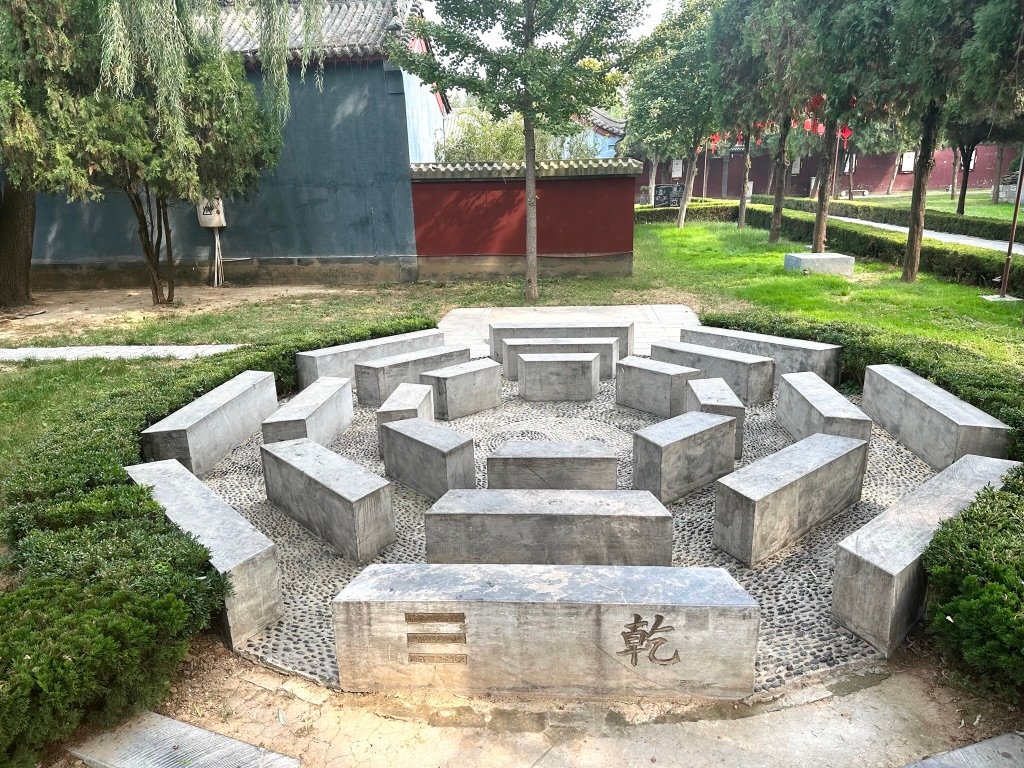
Dad’s Photo — Youlicheng (羑里城, Yǒulǐchéng), Henan: The Eight Trigrams (八卦, Bāguà) made physical at Youlicheng. Closest to the camera is Qián (乾, ☰) — three unbroken yang lines, traditionally associated with Heaven. These eight basic combinations of broken and unbroken lines form the building blocks from which the 64 hexagrams of the Changes are constructed.
A framework for representing different relationships and patterns within:
A CHANGING WORLD.
🌍 Fuxi 伏羲: Observe Nature, Find the Pattern
Chinese cultural tradition associates:
Fuxi (伏羲, Fúxī)
with observing:
HEAVEN 天
EARTH 地
and the patterns of the natural world.
Sun and moon.
Mountains and rivers.
Animals and plants.
Seasons.
Weather.
Movement and change.
And tradition associates him with the:
八卦.
🔥
Dad likes the intellectual instinct behind the story:
OBSERVE NATURE
↓
NOTICE RELATIONSHIPS
↓
LOOK FOR PATTERNS
↓
BUILD A FRAMEWORK
That’s a wonderfully accessible doorway into 八卦.
🪜 Western Handrail: Humans Love Turning Complexity Into Frameworks
Western travelers don’t need a direct equivalent.
Think simply about the human instinct behind:
maps,
classification systems,
models
and:
frameworks.
The world is overwhelmingly complicated.
So we ask:
“Can a smaller system help us organize what we’re seeing?”
🔥
The Bagua belongs to its own ancient Chinese intellectual tradition.
But the instinct is recognizable:
MAKE COMPLEXITY THINKABLE.
⚠️ Deep China Evidence Sign
One important distinction.
伏羲画八卦
Fuxi creates/draws the Eight Trigrams
belongs to:
CHINESE CULTURAL TRADITION.
We should not present it as though archaeology has established:
“A historically verified man named Fuxi invented this exact diagram on this date.”
😂
Likewise, the familiar later arrangements of the trigrams have their own complicated intellectual histories.
So:
TRADITION MATTERS.
But:
TRADITION ≠ ARCHAEOLOGICAL PROOF.
☯️ 先天八卦 and 后天八卦
Later tradition distinguishes two famous arrangements:
先天八卦 — Xiāntiān Bāguà
Earlier-Heaven Eight Trigrams
traditionally associated with:
Fuxi 伏羲
and:
后天八卦 — Hòutiān Bāguà
Later-Heaven Eight Trigrams
traditionally associated with:
King Wen 周文王.
For a first-time Western reader:
DO NOT MEMORIZE THE POSITIONS.
😂
Dad isn’t setting an exam.
The useful beginner’s handrail is simply:
先天
think underlying relationships and order
while:
后天
think change unfolding in the experienced world
That’s deliberately simplified.
Enough to open the door.
👑 And Now We’re Back at Youlicheng
This is where the rabbit returns to:
King Wen.
According to Chinese tradition, during Ji Chang’s confinement at:
Youli 羑里,
he became associated with the further development of the:
Changes.
Tradition connects King Wen with:
八卦
being developed into the:
六十四卦 — liùshísì guà
Sixty-Four Hexagrams
and with the textual tradition of:
《周易》 — Zhōuyì
Changes of Zhou.
🔥
Now the prisoner at Youli isn’t remembered only as:
A POLITICAL FIGURE.
He becomes connected with:
AN INTELLECTUAL TRADITION ABOUT CHANGE.
🔢 From Eight to Sixty-Four
Take the eight trigrams.
Combine one with another.
Now we have:
64 HEXAGRAMS.
Each consists of:
SIX LINES
formed from different configurations associated with:
YIN
and:
YANG.
🔥
The framework has become much richer.
Different configurations.
Different relationships.
Different stages of change.
Different situations.
And Dad thinks the easiest question for a Western beginner is:
“Not only WHAT is happening — but WHAT IS IT BECOMING?”
🧠 Life Is Not a Photograph
A photograph freezes:
ONE MOMENT.
Life doesn’t.
A strong political position can weaken.
A weak position can strengthen.
Relationships change.
Opportunities appear.
Opportunities disappear.
Circumstances turn.
🔥
King Wen himself is almost the perfect illustration.
At Youlicheng:
PRISONER UNDER SHANG.
Later remembered as:
KING WEN OF ZHOU.
His son will eventually:
DEFEAT SHANG.
😳
Talk about:
CHANGE.

Halfway Sting Check
We started with:
NATURE.
Sun and moon.
Day and night.
Growth and decline.
↓
阴阳
↓
阴中有阳,阳中有阴
↓
CHANGE + RELATIONSHIP
↓
八卦
↓
伏羲
traditional association
↓
先天八卦
↓
文王
↓
后天八卦
↓
六十四卦
↓
《周易》
🔥
But this still doesn’t explain why the Changes eventually became:
群经之首
“the foremost of the Classics.”
Or why:
Confucius
gets pulled into the rabbit.
Or why ideas about:
CHANGE, BALANCE, TIMING AND EXTREMES
became so deeply embedded in later Chinese thought.
And it definitely doesn’t explain why…
more than 3,000 years later…
Dad found:
《易经》
at an:
ANTIQUE MARKET IN DEZHOU.
😭😂🐇
That’s the next course.
Section 3 — From 《周易》 to 群经之首: Learning to Think About Change
At Youlicheng, we began with:
A PRISONER.
Ji Chang — the future:
King Wen of Zhou (周文王, Zhōu Wénwáng).
Chinese tradition connects his confinement here with the development of:
《周易》 — Zhōuyì
Changes of Zhou
But the story doesn’t end with King Wen.
Far from it.
Across later centuries, generations of Chinese thinkers kept:
READING IT.
INTERPRETING IT.
COMMENTING ON IT.
and:
FINDING NEW MEANINGS INSIDE IT.
🔥
Eventually, the Changes became one of the foundational works of Chinese classical thought:
《易经》 — Yìjīng
Classic of Changes / I Ching
and acquired an extraordinary traditional description:
群经之首 — qún jīng zhī shǒu
“the foremost of the Classics.”
That’s quite a journey for a text traditionally connected with:
A PRISONER AT YOULI.
🧠 Start With One Character: 易
For a first-time Western reader, Dad would begin with:
易 — yì
change
Because that’s the intellectual doorway.
The world doesn’t stay still.
People change.
Relationships change.
Political power changes.
Seasons change.
Circumstances change.
Strength becomes weakness.
Weakness can become strength.
🔥
So instead of asking only:
“What IS the situation?”
the Changes encourages another kind of question:
“WHAT IS THE SITUATION BECOMING?”
That is much more interesting.

🪜 Western Handrail: Don’t Read Life Like a Photograph — Read It Like a Movie
A photograph tells you:
WHAT IS THERE NOW.
A movie shows:
DIRECTION.
Where did this come from?
Where is it moving?
What is beginning to change?
🔥
That’s a useful Western handrail into the Yijing.
Don’t freeze the situation.
Look for:
MOVEMENT.
RELATIONSHIP.
TIMING.
and:
TRANSFORMATION.
King Wen’s own story almost illustrates the point perfectly.
At Youli:
PRISONER UNDER SHANG.
Later:
FOUNDING FIGURE OF ZHOU.
Then his son:
DEFEATS SHANG.
History itself moved.
👨🏫 Then Confucius Enters the Rabbit Hole
Of course he does.
😂🐇
Later Chinese tradition strongly connected:
Confucius (孔子, Kǒngzǐ)
with the study and interpretation of the Changes.
The commentarial materials known as:
《易传》 — Yìzhuàn
Commentaries on the Changes
and traditionally called:
十翼 — Shí Yì
“Ten Wings”
became enormously influential in philosophical readings of the work.
These commentaries helped later readers think about:
Heaven and Earth,
human conduct,
order,
relationships
and:
change.
🔥
Traditional accounts associated Confucius personally with the Ten Wings.
Modern scholarship treats their authorship and formation as much more complex.
So Dad would NOT simply write:
“Confucius wrote the Ten Wings.”
as settled historical fact.
The more useful point is:
CONFUCIAN INTERPRETATION HELPED TURN THE CHANGES INTO ONE OF CHINA’S GREAT PHILOSOPHICAL CLASSICS.
🧠 So What Kind of Thinking Came Out of This World?
Dad needs to be careful here.
We should NOT say:
“All Chinese philosophy comes from the Yijing.”
😂
Obviously not.
Chinese thought developed through many:
texts,
schools,
thinkers
and:
historical periods.
But the Yijing became one of the great places where generations explored themes that recur widely in Chinese intellectual culture:
CHANGE
RELATIONSHIP
TIMING
BALANCE
TRANSFORMATION
and:
THE DANGER OF EXTREMES.
🔥
Here are a few handrails Western travelers can actually remember.
☯️ 1. 阴中有阳,阳中有阴
We met this in Section 2:
阴中有阳,阳中有阴
Yīn zhōng yǒu yáng, yáng zhōng yǒu yīn
Within yin there is yang.
Within yang there is yin.
The lesson isn’t:
EVERYTHING IS 50/50.
😂
It’s:
DON’T FORCE THE WORLD INTO ABSOLUTE BOXES.
Something can be predominantly one way while already containing:
ANOTHER TENDENCY.
That’s why Dad likes the image of:
NOON.
The sun is at its highest…
but that very moment begins its movement toward:
SUNSET.
🔥
🔄 2. 物极必反 — Extremes Contain the Possibility of Reversal
Another familiar Chinese expression:
物极必反 — wù jí bì fǎn
Very loosely:
when something reaches an extreme, it tends toward reversal.
The moon becomes full…
then wanes.
Day reaches its height…
then moves toward night.
Winter reaches its depth…
then moves toward spring.
🔥
For a traveler trying to understand Chinese ways of thinking, this gives a useful instinct:
DON’T ASSUME THE PRESENT CONDITION WILL CONTINUE FOREVER.
Look at:
DIRECTION.
An apparent strength can contain future weakness.
An apparent low point can contain the beginning of recovery.
🔁 3. 周而复始 — Things Move Through Cycles
Then:
周而复始 — zhōu ér fù shǐ
completing a cycle and beginning again
Again:
NOT “HISTORY REPEATS EXACTLY.”
😂
Think more simply about nature:
day and night,
seasons,
growth and decline,
waxing and waning.
Chinese thought repeatedly notices:
PATTERNS OF RETURN.
But the new cycle doesn’t necessarily mean:
NOTHING CHANGED.
Spring returns.
It isn’t literally:
LAST YEAR’S SPRING.
🔥
Continuity and change can coexist.
⚖️ 4. 中庸 — Not Simply “Take the Middle”
Then we meet another famous Chinese idea:
中庸 — Zhōngyōng
traditionally translated as Doctrine of the Mean
This belongs to the Confucian tradition rather than simply being “an idea invented by the Yijing.”
But it fits our broader Chinese conversation about:
RELATIONSHIP + BALANCE + CIRCUMSTANCE.
Western beginners sometimes hear 中庸 and think:
“Everything in moderation.”
Useful first doorway.
Too simple.
😂
中庸 does NOT mean:
ALWAYS CHOOSE 50%.
Sometimes the appropriate response is:
ACT STRONGLY.
Sometimes:
WAIT.
Sometimes:
ADVANCE.
Sometimes:
RETREAT.
The deeper question is:
“WHAT RESPONSE FITS THESE CIRCUMSTANCES?”
🔥
Balance isn’t necessarily a fixed point.
It can require:
ADJUSTMENT AS THE SITUATION CHANGES.
🪜 Western Handrail: Think Balance on a Bicycle
This may be easier than:
“Everything in moderation.”
Imagine riding a bicycle.
To remain balanced, you don’t freeze your body at:
EXACTLY 50/50.
😂
You continuously make:
SMALL ADJUSTMENTS
in response to:
speed,
direction,
terrain
and:
movement.
Balance is therefore:
DYNAMIC.
Not:
STATIC.
That’s a useful beginner’s handrail for the broader Chinese instinct Dad is trying to show here.
⚠️ Don’t Turn Four Chinese Ideas Into One Philosophy
One more evidence and interpretation warning.
Dad has placed:
阴阳
物极必反
周而复始
and:
中庸
beside one another because they help Western beginners recognize recurring interests in Chinese thought.
But don’t write:
“The Yijing created all four.”
It didn’t.
Their textual histories and philosophical contexts are different.
🔥
The useful connection is:
A RECURRING INTEREST IN HOW THINGS RELATE, CHANGE, REACH LIMITS AND REQUIRE APPROPRIATE RESPONSES.
That’s the handrail.
Not a fake family tree.
📖 So Why 群经之首?
Now the traditional phrase makes more sense.
群经之首
“the foremost of the Classics”
doesn’t mean:
“Everybody in Chinese history agreed that this was objectively Book No. 1.”
😂
It’s an honorific expression reflecting the extraordinary status the Yijing acquired within Chinese classical culture.
Generation after generation found ways to think through:
NATURE.
CHANGE.
HUMAN ACTION.
ORDER.
TIMING.
RELATIONSHIP.
through the Changes and its commentarial traditions.
🔥
The remarkable thing isn’t simply that:
AN OLD BOOK SURVIVED.
It’s that:
PEOPLE KEPT THINKING WITH IT.
🐇 And Then Dad Finds 《易经》 in Dezhou

This is Dad’s favorite little ending to the intellectual rabbit.
Much later, Dad & Elaine were in:
Dezhou (德州, Dézhōu)
in Shandong.
Dad was wandering through an:
ANTIQUE MARKET.
Not Youlicheng.
Not a university.
Not a grand museum exhibition.
😂
And there it was:
《易经》.
Dad photographed it.
🐇🔥
📸 Dad’s Rabbit — 群经之首 Goes to the Antique Market
That photograph is useful because it reminds us that the Yijing didn’t remain only:
庙堂之上
in elite scholarly and official culture.
Across its long history, it also entered:
民间 — mínjiān
popular / ordinary society.
Printed editions.
Readers.
Collectors.
Everyday cultural references.
🔥
A text traditionally honored as:
群经之首
could live among:
SCHOLARS
and:
ORDINARY READERS.
Dad had followed the rabbit from:
YOULICHENG
↓
KING WEN
↓
《周易》
↓
CONFUCIAN INTERPRETATION
↓
《易经》
↓
群经之首
↓
民间
↓
AN ANTIQUE MARKET IN DEZHOU.
😂🐇
Some classics refuse to stay inside the history book.

🐞 Sting Check
At Youlicheng, Chinese tradition gives us:
A PRISONER.
That prisoner becomes:
KING WEN.
His name becomes connected with:
《周易》.
And across later centuries the Changes becomes:
《易经》
and:
群经之首.
🔥
But Dad thinks the most useful lesson for Western travelers is simpler.
Don’t ask only:
“What is happening?”
Sometimes ask:
“WHAT IS CHANGING?”
“WHAT IS ALREADY DEVELOPING INSIDE THE PRESENT SITUATION?”
“HAS SOMETHING REACHED AN EXTREME?”
and:
“WHAT RESPONSE FITS THIS MOMENT?”
Those questions help us understand why the Changes became much more than:
AN ANCIENT TEXT.
It became part of:
CHINA’S INTELLECTUAL VOCABULARY.
And now Dad needs to put the philosophy book down.
😂
Because back at Youlicheng:
SHANG STILL RULES.
King Wen will die before seeing the final victory.
His son will finish the political story.
And the Shang world we encountered at Yinxu is about to:
FALL.
Section 4 — When King Wen’s Family Replaced Shang With Zhou
After:
阴阳,
八卦,
《周易》
and:
群经之首…
Dad needs to remind everyone of one rather important detail.
😂
Back at:
Youlicheng (羑里城, Yǒulǐchéng),
SHANG STILL RULED.
Ji Chang — the future:
King Wen of Zhou (周文王, Zhōu Wénwáng)
was still living inside the political world of the Shang dynasty.
The great Zhou victory:
HAD NOT HAPPENED YET.
And King Wen himself would not live to see it.
👑 King Wen Built — His Son Finished
After his release, Ji Chang continued strengthening Zhou power in the west.
Later tradition remembers him as:
King Wen — the “Cultured King.”
But the final overthrow of Shang would be accomplished by his son:
King Wu of Zhou (周武王, Zhōu Wǔwáng).
🔥
This father-son sequence is important.
KING WEN
builds Zhou’s power and prestige
↓
KING WU
leads the final campaign against Shang
And around:
1046 BCE
we reach one of the great turning points in early Chinese history.
⚔️ The Battle of Muye 牧野之战
The decisive confrontation is traditionally associated with:
Battle of Muye (牧野之战, Mùyě Zhīzhàn).
Zhou forces and their allies confronted the army of the last Shang ruler.
Shang was defeated.
Its ruling order collapsed.
And the political world changed.
SHANG 商
↓
ZHOU 周
🔥
The man once detained under Shang power had died.
But:
HIS FAMILY WON.
🪜 Western Handrail: The Prisoner’s Son Defeats the Regime
This is the simplest Western handrail for the whole Youlicheng story.
Forget the dynastic labels for a moment.
A rising regional leader is:
DETAINED BY THE RULING POWER.
He survives.
His political base continues growing.
He dies.
Then his son leads the coalition that:
OVERTHROWS THE OLD REGIME.
😳
Now go back and stand at Youlicheng.
The place feels different.
You aren’t merely looking at:
“the prison of an ancient king.”
You’re standing inside the:
BEFORE
of a political transformation that would shape Chinese history for centuries.
🧠 But Winning Creates Another Problem
Dad’s political-science brain immediately asks:
“Fine. You conquered Shang. Why should anyone accept YOU as the rightful ruler?”
😂
Military victory answers:
WHO WON?
It does not automatically answer:
WHO SHOULD RULE?
And that brings us to one of the most influential political ideas associated with the Zhou world:
天命 — Tiānmìng
Mandate of Heaven
☁️ The Mandate of Heaven: Victory Needs an Explanation
The Zhou political tradition developed the argument that legitimate rule depended upon:
HEAVEN’S MANDATE.
But crucially:
THE MANDATE WAS NOT NECESSARILY PERMANENT.
A ruling house could lose it through serious failure or misconduct.
The Zhou could therefore explain the fall of Shang like this:
SHANG ONCE HAD LEGITIMATE RULE
↓
SHANG RULE DETERIORATED
↓
HEAVEN WITHDREW ITS MANDATE
↓
ZHOU RECEIVED THE MANDATE
🔥
Now conquest becomes:
A MORAL-POLITICAL STORY.
Not merely:
“We were stronger, so we won.”
But:
“The old ruler had lost the right to rule.”
That idea would echo through Chinese political history for a very long time.
🪜 Western Handrail: Winning the Throne Is Not the Same as Legitimizing It
Western history knows this problem too.
A new dynasty.
A successful conqueror.
A revolution.
A disputed succession.
After the fighting ends, the new rulers still need a story explaining:
WHY THEIR RULE IS LEGITIMATE.
Different civilizations produced different answers.
The Zhou answer became:
天命.
🔥
And that answer contained a potentially uncomfortable implication for every later ruler:
If Shang could lose the mandate… so could you.
😳
That is what makes 天命 politically interesting.
🐇 And Now Our Yijing Rabbit Connects Back to Politics
Notice something.
For two sections we’ve been thinking about:
CHANGE.
Nothing stays permanently fixed.
Strength can become weakness.
An extreme can contain the beginning of reversal.
Circumstances change.
Then look at the political story:
SHANG — POWERFUL
↓
ZHOU — SUBORDINATE / RISING
↓
KING WEN — DETAINED
↓
ZHOU POWER GROWS
↓
SHANG FALLS
↓
ZHOU RULES
😳
Dad is NOT claiming:
“The Yijing predicted the Zhou conquest.”
😂
That’s not the point.
The interesting connection is conceptual:
POLITICAL POWER CHANGES TOO.
No dynasty possesses:
PERMANENT STRENGTH.
That lesson will repeat many times in Chinese history.
👨👦 Then Another Zhou Figure Steps Forward
King Wu won the great political victory.
But victory doesn’t automatically create:
A STABLE DYNASTY.
After King Wu’s death, the Zhou world faced another difficult transition.
And now we meet another person Dad keeps chasing around China:
Duke of Zhou (周公, Zhōugōng).
😂🐇
He was King Wu’s younger brother and uncle to the young:
King Cheng of Zhou (周成王, Zhōu Chéngwáng).
The Duke of Zhou became deeply associated in later Chinese memory with:
consolidating Zhou rule,
political order,
ritual institutions
and:
the early Zhou settlement.
🔥
Which is why Dad & Elaine eventually found:
ZHOUGONG TEMPLES
in more than one province.
The rabbit had escaped Anyang.
Again.
🧥 Dad’s Coat Rack: The Shang–Zhou Transition
If everything has become too much, keep only this:
YINXU 殷墟
Shang royal world
↓
YOULICHENG 羑里城
Ji Chang / future King Wen under Shang power
↓
KING WEN 周文王
Zhou grows stronger
↓
KING WU 周武王
↓
MUYE 牧野
c. 1046 BCE
↓
SHANG FALLS
↓
WESTERN ZHOU 西周
↓
DUKE OF ZHOU 周公
consolidation + political memory
🔥
That’s enough.
No indigestion.
😂
🐇 And Now Dad Wants to Go West
This is where Youlicheng stops being:
AN ISOLATED HISTORICAL SITE.
Because once you ask:
“Who were these Zhou people before they defeated Shang?”
the rabbit starts running west.
Toward:
Qishan (岐山, Qíshān)
and:
Zhouyuan (周原, Zhōuyuán)
in Shaanxi Province (陕西省, Shǎnxī Shěng).
🔥
There, Dad & Elaine walked through the landscape associated with:
THE ZHOU HOMELAND.
Now our route becomes:
ANYANG
see the Shang world
↓
YOULICHENG
meet the future Zhou under Shang power
↓
QISHAN / ZHOUYUAN
enter Zhou’s own homeland
↓
BAOJI
see the bronzes and inscriptions of the early Zhou world
😳
Suddenly several separate China trips become:
ONE CONNECTED STORY.
🪜 Western Travel Handrail: Follow the Rival Home
Imagine learning about the fall of one ancient civilization…
then traveling to:
THE HOMELAND OF THE PEOPLE WHO REPLACED IT.
That’s what makes the rabbit so satisfying.
At Yinxu:
LOOK AT SHANG.
At Youlicheng:
WATCH ZHOU APPROACH.
At Qishan and Zhouyuan:
GO HOME WITH ZHOU.
🔥
History stops being:
DYNASTY A → DYNASTY B.
It becomes:
PEOPLE + PLACES + RIVALRY + CHANGE.
Final Sting
Dad & Elaine came to Youlicheng expecting:
KING WEN.
Instead we found a hinge.
On one side:
SHANG.
On the other:
ZHOU.
And sitting in between:
A PRISONER.
A man later remembered as:
KING WEN.
A man associated in Chinese tradition with:
《周易》.
A father whose son would:
DEFEAT SHANG.
🔥
That’s why Youlicheng matters.
Not because every stone you see today is 3,000 years old.
Not because every later tradition can be treated as archaeological fact.
But because the place gives Western travelers something extremely useful:
A HUMAN WAY TO SEE THE SHANG–ZHOU TRANSITION.
At Yinxu:
SHANG STILL SPEAKS.
At Youlicheng:
ZHOU IS WAITING IN THE WINGS.
And west in Qishan and Zhouyuan…
ZHOU COMES HOME.
🐇🔥
See the place. Ask the bigger question. Understand China better.
🐇 WHERE TO FOLLOW NEXT
🐢 FOLLOW SHANG
Beyond Beijing: Go to Yinxu 殷墟 — Where the Shang Dynasty Speaks in Its Own Words
👑 FOLLOW KING WEN HOME
Beyond Xi’an: Qishan 岐山 & Zhouyuan 周原 — Walking Through the Homeland of the Zhou
🏺 FOLLOW EARLY ZHOU INTO BRONZE
Deep China: He Zun 何尊 — The 3,000-Year-Old Bronze That Bears the Characters 中国
🧠 GET THE BIGGER PICTURE
Deep China: Why the Zhou Dynasty 周朝 Matters So Much to Chinese History
Section 5 — How to Visit Youlicheng: Complete the Shang–Zhou Story
After:
King Wen,
Shang,
Zhou,
阴阳,
八卦,
《易经》
and:
3,000 years of Chinese intellectual history…
😂
Dad wants to bring this back to something very simple:
SHOULD YOU ACTUALLY VISIT YOULICHENG?
If you’re already in:
Anyang (安阳, Ānyáng),
and ancient Chinese history interests you…
Dad says:
YES.
But not as an isolated attraction.
The real value of Youlicheng is:
WHAT YOU VISIT BEFORE AND AFTER IT.
🐢 First: Visit Yinxu
Start with:
Yinxu (殷墟, Yīnxū).
This is essential.
At Yinxu you encounter:
SHANG WHILE SHANG IS STILL SHANG.
Royal power.
Oracle bones.
Bronzes.
Tombs.
King Wu Ding.
Fu Hao.
Contemporary Shang writing.
🔥
Don’t rush immediately toward Zhou.
Let Shang have:
ITS OWN VOICE.
Then go to Youlicheng.
👑 Then: Go to Youlicheng
Now the perspective changes.
At Yinxu:
SHANG IS THE CENTER.
At Youlicheng:
THE FUTURE ZHOU ENTERS THE STORY.
This is where the visit becomes much more meaningful than simply:
“Here is another ancient Chinese historical site.”
You already know what Shang looked like.
Now you meet:
JI CHANG
while he is still living under that political order.
🔥
The two sites:
TALK TO EACH OTHER.
⏱️ How Much Time?
Youlicheng itself does not require:
AN ENTIRE DAY.
And Dad wouldn’t try to turn it into one.
😂
For most international travelers, allow roughly:
1½–2½ HOURS
depending on how slowly you read the displays and explore the site.
The important thing isn’t:
QUANTITY OF ATTRACTIONS.
It’s:
UNDERSTANDING WHAT YOU’RE LOOKING AT.
🚗 Getting There
Youlicheng is outside central Anyang, in the wider Anyang/Tangyin area.
For international travelers, Dad would favor:
CAR / DIDI
or:
PRIVATE DRIVER
especially if combining several historical sites.
And if you’re already hiring a knowledgeable local guide for Anyang:
KEEP THE GUIDE.
😂
Youlicheng is exactly the kind of place where interpretation adds more value than simply being dropped at the entrance.
A good guide can help connect:
SHANG
↓
KING WEN
↓
《周易》
↓
ZHOU
without requiring Dad’s entire article to travel with you.
🧠 Don’t Expect Yinxu
This is important for managing expectations.
Youlicheng is not:
ANOTHER YINXU.
At Yinxu, archaeology itself is the star.
At Youlicheng, much of the visitor experience is about:
HISTORICAL MEMORY
and:
LATER COMMEMORATION.
🔥
That means you should approach the two sites differently.
At Yinxu ask:
What did archaeology actually uncover?
At Youlicheng also ask:
How did later Chinese generations remember King Wen and this place?
Both questions are worthwhile.
They’re simply:
DIFFERENT KINDS OF HISTORY.
🪜 Western Travel Handrail: Battlefield vs Birthplace of an Idea
Western travelers already understand this distinction.
Sometimes you visit:
AN ARCHAEOLOGICAL SITE
because physical evidence survives.
Sometimes you visit:
A MEMORIAL LANDSCAPE
because generations attached historical meaning to the place.
You don’t judge the second by asking:
“Where are all the 3,000-year-old buildings?”
😂
You ask:
“WHY DID PEOPLE KEEP REMEMBERING THIS PLACE?”
That’s the right question for Youlicheng.
🗓️ Dad’s Anyang History Rhythm
If Chinese history is your reason for visiting Anyang, Dad would think in terms of:
2 FULL DAYS MINIMUM.
Not:
“Can I squeeze Anyang between two trains?”
😭😂
A comfortable history-focused rhythm:
DAY 1
YINXU 殷墟
Take your time.
Shang capital.
Oracle bones.
Fu Hao.
Museum and archaeological landscape.
DAY 2
National Museum of Chinese Writing
中国文字博物馆
then:
YOULICHENG 羑里城
Now the sequence becomes:
SHANG SPEAKS
↓
FOLLOW THE WRITING
↓
WATCH SHANG BEGIN TURNING INTO ZHOU
🔥
That’s an excellent two-day historical meal.
🚄 And Anyang Is Surprisingly Easy From Beijing
This is the part Dad thinks first-time international travelers underestimate.
Anyang isn’t:
“deep China requiring three buses, a donkey and an archaeological permit.”
😂
High-speed rail makes it surprisingly accessible from:
Beijing.
For planning purposes, fast trains from Beijing to:
Anyang East Railway Station (安阳东站, Ānyáng Dōngzhàn)
can take roughly:
2½–3 HOURS
depending on the service.
Train schedules change, so check your actual date on:
12306
or:
Trip.com.
But the travel proposition is extraordinary:
BREAKFAST IN BEIJING.
BRONZE AGE CHINA IN THE AFTERNOON.
🔥
🐇 But Dad’s Favorite Route Doesn’t End in Anyang
This is where the rabbit becomes a journey.
Start at:
YINXU 殷墟
Shang at its royal center
↓
YOULICHENG 羑里城
future King Wen under Shang power
↓
then travel west toward:
QISHAN 岐山
and:
ZHOUYUAN 周原
the Zhou homeland
↓
then:
BAOJI 宝鸡
early Zhou bronzes and He Zun
😳🔥
Now you’re no longer merely reading:
SHANG → ZHOU
on a timeline.
You’re:
TRAVELING THROUGH THE TRANSITION.
🪜 Western Handrail: Follow the Story Across the Map
Imagine learning about the fall of one ancient political order…
then physically traveling toward:
THE HOMELAND OF THE PEOPLE WHO REPLACED IT.
That’s the Deep China version.
YINXU
shows you:
Who was ruling?
YOULICHENG
asks:
Who was rising?
ZHOUYUAN
asks:
Where did they come from?
BAOJI
shows you:
What did their early political world leave behind?
🔥
That’s much more satisfying than:
“Today we visited four attractions.”
Final Sting — Youlicheng Is a Hinge
Dad doesn’t think Youlicheng needs to compete with:
YINXU.
It shouldn’t.
Yinxu is one of the great archaeological sites of ancient China.
Youlicheng does something different.
IT CONNECTS STORIES.
Shang.
↓
King Wen.
↓
《周易》.
↓
King Wu.
↓
Zhou.
🔥
It is a:
HINGE.
Look backward:
SHANG STILL RULES.
Look forward:
ZHOU IS COMING.
And sitting in between is:
KING WEN.
A political prisoner in one story.
A founding ancestor in another.
And, in Chinese cultural tradition, a figure inseparable from:
《周易》
and one of China’s deepest intellectual conversations about:
CHANGE.
❤️ Dad’s Favorite Way to Remember Youlicheng
At:
Yinxu,
Dad heard the Shang speak.
At:
Youlicheng,
Dad could almost hear the historical clock:
TICK.
😂
The old political order still exists.
The future one hasn’t arrived.
But something is already:
CHANGING.
Perhaps that’s why:
《易》
is such a fitting rabbit to find here.
🔥
See the place. Ask the bigger question. Understand China better.
🐇 WHERE TO FOLLOW NEXT
🐢 LOOK BACK TO SHANG
Beyond Beijing: Go to Yinxu 殷墟 — Where the Shang Dynasty Speaks in Its Own Words
☯️ FOLLOW THE WRITTEN TRADITION
Deep China: From Oracle Bones to Your Phone — Why Chinese Writing Matters So Much
👑 FOLLOW KING WEN HOME
Beyond Xi’an: Qishan 岐山 & Zhouyuan 周原 — Walking Through the Homeland of the Zhou
🏺 FOLLOW EARLY ZHOU INTO BRONZE
Deep China: He Zun 何尊 — The 3,000-Year-Old Bronze That Bears the Characters 中国
🧠 GET THE BIGGER ZHOU STORY
Deep China: Why the Zhou Dynasty 周朝 Matters So Much to Chinese History